



Exosome market shifts from quantity to proven efficacy


Key takeaways
- The exosome market is shifting from counting vesicles to proving what they actually do, with efficacy and mechanistic evidence becoming differentiators.
- Plant-derived exosome-like nanovesicles are gaining favor over human-derived ones for their easier sourcing, sustainability, and smoother regulatory acceptance.
- Ashland is advancing flower-derived exosome research through technologies like Plant Small RNA.

Exosomes have traveled from the frontiers of regenerative medicine, through the aesthetic clinic, and now onto the shelves of the cosmetics aisle. They have become one of skin care’s buzziest ingredients, but the industry is now looking beyond exosome amount and looking for practical function.
Exosomes are microscopic messengers, released by skin cells, that contain proteins, lipids, and genetic material. In cosmetics, exosomes help strengthen the communication between skin cells that aging impairs. They are touted as next-generation actives that boost cell renewal and collagen production.
Innova Market Insights data flags that the growing interest in exosomes has resulted in a 24% CAGR in patent publications over the past five years.
Personal Care Insights speaks to three experts from Ashland about exosomes’ evolving science, regulatory landscape, and their future. We talk to Laurine Bergeron, new product development manager, Active Biofunctionals; Audrey Le Mestr, innovation team leader, Active Biofunctionals; and Eloïse Dewitte, global marketing manager, Active Biofunctionals.
The biofunctionals supplier tells us that the market is approaching a turning point.
“Until now, much of the discussion around exosomes has focused on their presence, origin, or quantity within a formulation. While characterization and quantification remain essential, they are no longer sufficient to differentiate products. Consumers and brands increasingly want to understand what these vesicles actually do,” says the company.
Ashland states that the key questions are no longer: “How many exosomes are present?” but “How do they interact with skin biology?” and “What measurable benefits do they deliver?”
It says future innovation will focus on generating robust mechanistic evidence, demonstrating how exosome-like vesicles interact with biological pathways, and linking these mechanisms to clinically meaningful outcomes.
“The most successful exosome-based cosmetic solutions will not necessarily be those containing the highest number of vesicles, but those capable of demonstrating a credible chain of evidence — from characterization and biological activity to validated consumer benefits. In that sense, we believe the market is evolving from an era of exosome quantity to an era of exosome functionality and proven efficacy.”
What are exosomes?
Exosomes are naturally occurring nano-sized extracellular vesicles secreted by virtually all living organisms, from animals to plants. They are released by cells containing proteins, lipids, and nucleic acids.
The biological messengers carry a complex cargo of proteins, lipids, nucleic acids, and signaling molecules that directly reflect the identity and physiological state of the parent cell. These vesicles facilitate intercellular communication and deliver bioactive molecules, positioning them as a potential solution for skin regeneration and treatments. Plant-derived exosomes are emerging as a sustainable alternative to human-derived sources.
Exosomes are distinguished from conventional delivery systems such as liposomes or other synthetic nanocarriers. Traditional delivery systems are engineered primarily to transport active ingredients and generally have a relatively simple and standardized composition. Exosomes, by contrast, are naturally assembled biological structures with an intrinsic signaling function.
According to Ashland, a key difference is their targeting capability. Exosomes display specific transmembrane proteins and membrane markers on their surface that help guide their interactions with recipient cells. These surface molecules contribute to their ability to deliver biological messages in a selective manner, making exosomes not only carriers, but also active mediators of intercellular communication.
Their ability to address concerns such as hyperpigmentation, acne scars, and signs of aging makes them ideal for customized skin care solutions. Furthermore, they can effectively stimulate collagen production, improve skin elasticity, and promote wound healing, making them desirable for anti-aging and rejuvenation solutions.
How exosomes ended up in cosmetics
According to the scientific timeline, extracellular vesicles were first identified in the 1950s, but Ashland says literature around exosomes in skin and hair care has expanded significantly in recent years.
“A simple review of the literature highlights increasing numbers of publications describing benefits, including skin regeneration and wound healing, improved barrier function, reduced inflammation, promotion of collagen and elastin synthesis, reduction of melanogenesis, stimulation of hair growth, and repair of damaged hair follicles,” the company tells us.
Ashland says several forces have accelerated exosome use.
First, consumers increasingly seek science-backed, targeted, and biomimetic beauty solutions. Second, exosome research generated excitement because it bridges regenerative biology with cosmetic innovation. Finally, K-beauty played an influential role by positioning exosome technologies as non-invasive alternatives to traditional aesthetic procedures.
“Peer-reviewed studies have demonstrated the role of exosomes in cell-to-cell communication and tissue regeneration, which explains why they have attracted attention in dermatology and cosmetic science,” explains the company.
Ashland’s research has focused on plant-derived exosome-like nanovesicles (PELNs). For example, the company reports isolated rose-derived PELNs from Rosaliss Biofunctional increased expression of the epidermal repair biomarker MARCKSL1 by approximately 30% in human keratinocyte cultures.
In a separate study, the same extract increased levels of CD9-positive exosome-like vesicles released by keratinocytes by 28%, suggesting enhancement of skin-cell communication mechanisms.
“One of our most advanced proof-of-concept examples is Rosaliss Biofunctional, a Rosa centifolia extract inspired by regenerative medicine and designed to support skin repair. We demonstrated the presence of PELNs, characterized their morphology, quantified their concentration, and investigated their biological activity on skin-repair biomarkers and skin-derived exosomes,” says Ashland.
The company recently introduced Exoblossom, a set of capabilities focused on flower-released exosome-like nanovesicles derived from botanical sources. Its research builds on decades of expertise in botanical extraction and our proprietary technologies such as PSR (Plant Small RNA), which appears effective at enriching extracts in plant-derived exosome-like nanovesicles while preserving their integrity and bioactivity. 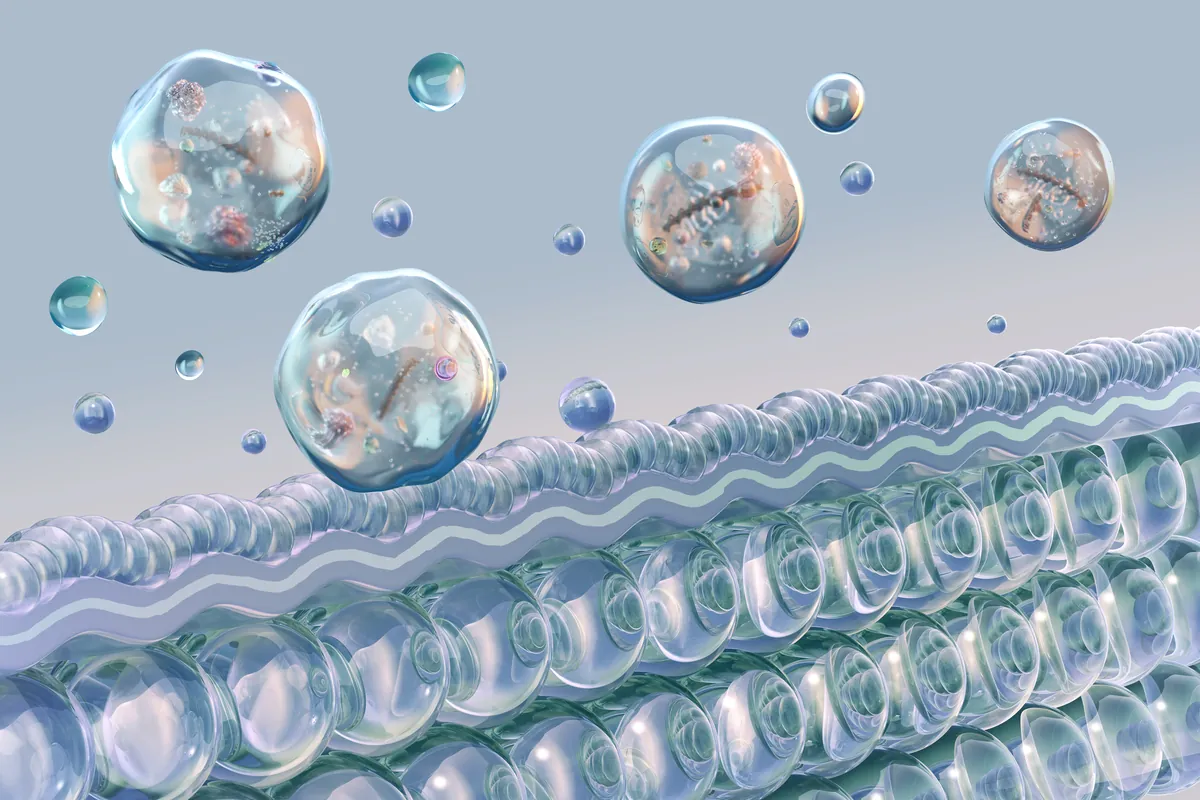 Exosomes are microscopic messengers that carry proteins, lipids, and genetic material between skin cells.
“We are also exploring flower-released exosome-like nanovesicles from lavender through Nightessence Biofunctional and from jasmine through Caressense Biofunctional, extending the concept toward nighttime skin biology and neurocosmetic pathways, respectively.”
Exosome and regulations
For all the interest in the cosmetics industry around exosomes, the technology sits in a contested regulatory space where science, marketing, and law often pull in different directions — starting with language itself.
“From a scientific perspective, it is important to clearly distinguish between naturally occurring exosomes, also called exosome-like nanovesicles, engineered exosomes, and synthetic exosome-inspired systems. Terminology is not always used consistently across the industry, creating regulatory and communication challenges,” Ashland tells us.
“One of the key lessons from the current exosome trend is the importance of scientific demonstration. Exosomes have become a powerful marketing term, but the industry must continue to improve standards for isolation, characterization, quantification, and efficacy testing.”
Because “exosome” carries both a precise scientific meaning and a looser marketing one, regulators have started to push back. From January 2025, South Korea’s Ministry of Food and Drug Safety banned the word “exosome” in cosmetic advertising to curb misleading, medical-sounding claims.
Beyond terminology, where the vesicles come from is also consequential. It shapes how a product is regulated and how easily it can be made at all.
“Plant-derived exosome-like nanovesicles may offer certain advantages because they are generally considered easier to work with than animal-derived materials and may raise fewer concerns related to immunogenicity, sourcing, and regulatory acceptance,” says Ashland.
The EU and South Korea both prohibit human cells and tissues in cosmetics. In the US, human-derived exosomes fall under the FDA’s HCT/P framework for human cell and tissue products, and because isolating them counts as significant processing, they’re regulated as drugs rather than cosmetics.
“The US, EU, and Asian markets differ substantially in how they classify products depending on composition, claims, and intended use. Cosmetic claims must remain within the cosmetic framework and avoid crossing into therapeutic or medical territory,” adds Ashland.
Earlier this year, the Taiwan Food and Drug Administration loosened certain requirements for human-derived exosomes in cosmetics. It made some long-term toxicity studies subject to case-by-case, risk-based assessment rather than mandatory across the board.
The change wasn’t a relaxation of Taiwan’s position — it remains one of Asia’s strictest markets for human-derived ingredients — but a move toward more proportionate, science-driven evaluation that recognizes not all exosomes carry the same risk profile.  Ashland’s research focuses on flower-released exosome-like nanovesicles from roses, lavender, and jasmine.
The future of exosomes
Exosome science is still at a relatively early stage in cosmetics, but Ashland believes the field will keep evolving over the coming years, driven by greater scientific rigor and a deeper understanding of biological mechanisms.
“Current research is moving beyond the simple identification of extracellular vesicles toward a comprehensive characterization of their cargo through proteomics, lipidomics, transcriptomics, and metabolomics.”
The specialty ingredients company says this deeper understanding will help establish which specific molecules and signaling pathways are responsible for the observed cosmetic benefits. Ashland is actively exploring these approaches as part of its research on flower-derived exosome-like nanovesicles.
“We also expect plant-derived exosome-like nanovesicles to gain increasing attention. Their natural origin, favorable sustainability profile, scalability, and ability to carry both vesicle-mediated signals and plant bioactives make them particularly attractive for the next generation of science-backed cosmetic products. Plant-derived systems may offer a compelling bridge between biotechnology, biomimicry, and botanical innovation,” Ashland concludes.