


Active Concepts reveals how pineapple waste can power clean cosmetics

Key takeaways
- Active Concepts researchers upcycled pineapple waste into a multifunctional biopolymer (PALF) for clean and sustainable cosmetic formulations.
- PALF delivers strong cosmetic performance, including antioxidant, anti-inflammatory, anti-pollution, and UV-protective benefits for skin and hair.
- The ingredient combines efficacy with clean beauty and sustainability credentials, offering easy formulation and broad application potential across cosmetics.

An R&D team from Active Concepts has upcycled pineapple scraps for use in sustainable skin care, sun care, and hair care products. With nearly 50% of the body of a pineapple typically getting discarded, the team has harnessed the underutilized potential of the fruit by developing a biopolymer for cosmetic formulations.
Optimizing the antioxidant, anti-inflammatory, and exfoliating properties naturally present in pineapple leaf crowns, the pineapple leaf fiber crosspolymer (PALF) has demonstrated promising results across a broad range of potential cosmetic applications.
Adding to its favorable bioactive properties, the biopolymer has also demonstrated high efficacy for anti-pollution applications and ultraviolet (UV) protection. The researchers underline the importance of combating the rise in extrinsic accelerants of cellular and visual aging exacerbated by industrialization and human movement.
Daniel Shill, first author and manager of Clinical Validation & Toxicological Assessment at Active Concepts, tells Personal Care Insights that cosmetics should offer protection in the form of physical barriers or by blunting molecular mechanisms to mitigate these factors in skin and hair aging.
“Beyond performance, PALF helps protect both skin and hair from everyday environmental stressors such as UV radiation and airborne pollution, demonstrating that sustainability-driven ingredients can also meet the high efficacy expectations of modern beauty consumers,” explains Shill.
Inside the research
The study was conducted on in vitro, in vivo, and ex vivo tissue. The in vivo sample group was defined as 20-45 years old, with normal to dry skin, and Fitzpatrick skin types I-IV — tones ranging from Caucasian to brown.
The findings show that PALF delivers multifaceted protective and performance benefits across skin and hair applications. At the cellular level, PALF reduces oxidative stress and inflammation while also mitigating the harmful effects of airborne pollution on cells, tissues, and organs. It further protects against UV-induced damage in both skin cells and hair fibers.
From a formulation and cosmetic performance perspective, PALF improves the dispersion of zinc oxide and color pigments, resulting in enhanced color properties and better skin coverage. In long-wear foundations, it increases transfer resistance while supporting skin hydration and strengthening the skin barrier. Additionally, PALF enhances the overall sensory experience of sunscreen formulations and improves the perceived wet- and dry-hair benefits in shampoo and conditioner products.
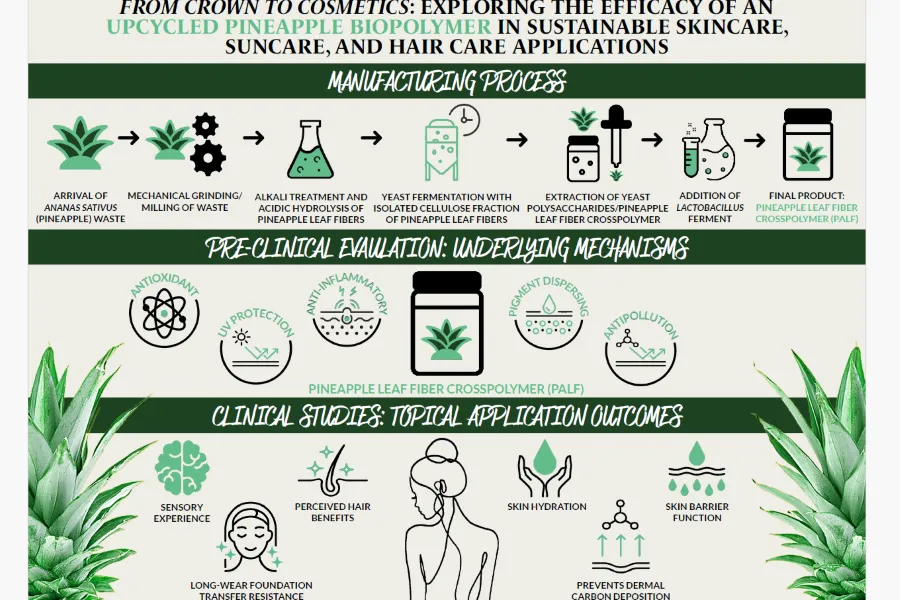 the biopolymer has demonstrated high efficacy for anti-pollution applications and UV protectionPALF of all trades
Due to its multifunctional activity and film-forming functionality, PALF is expected to have a wide range of applications in the cosmetics industry.
Regarding its practical applications, Kayla Goodson, clinical research scientist at Active Concepts and co-author of the research paper, tells Personal Care Insights that PALF’s incorporation “supports the development of high-performance formulations, particularly within anti-pollution and protective product categories, while also enhancing sensorial properties, texture, and overall product performance.”
“Based on these attributes, PALF would be well-suited for use in products such as lightweight daily SPF formulations, barrier repair creams, anti-pollution primers, and targeted scalp serums.”
“As an upcycled, plant-derived ingredient, PALF strongly aligns with sustainability-driven and clean beauty positioning,” adds Goodson, iterating the ingredients’ appeal to sustainability markets.
Hannah Stade, co-author, preclinical research scientist at Active Concepts, expressed her confidence in PALF regarding its versatility and applicability to the cosmetics industry, stating that they “don’t anticipate any major hurdles when it comes to integrating PALF into cosmetic formulations.” PALF demonstrates an example of modern bio-chemical ingenuity that addresses the contemporary necessity for sustainability-oriented research.
“It offers many of the qualities consumers are actively looking for today, strong performance paired with a clear sustainability story. From a formulator’s perspective, PALF is highly versatile; its nonionic nature allows it to incorporate easily into aqueous phases across a wide range of applications. With its combination of efficacy, ease of use, and responsible production, we’re excited to see PALF gain traction as a go-to ingredient in the industry,” she continues.
Maureen Drumwright, co-author and director of Research & Development at Active Concepts, tells us that the team does not have plans to pursue a patent for PALF at this time. “Instead, we rely on our technical expertise, formulation guidance, and quality standards to differentiate the technology in the marketplace.”
PALF is a valuable addition to a growing collection of sustainable and functional alternatives to cosmetic ingredients.” This research reinforces the idea that the future of cosmetic innovation lies not only in new ingredient technology but in rethinking waste streams as valuable, functional resources,” says Sejal Bhatt, director of Marketing at Active Concepts.
PALF demonstrates an example of modern bio-chemical ingenuity that addresses the contemporary necessity for sustainability-oriented research.
“We hope the beauty industry continues to recognize that ingredients like PALF can play a meaningful role in supporting environmental stability while delivering real, multifunctional benefits in cosmetic formulations,” adds Shill.