


EU locks in US tariffs, but French beauty wants full exemption as losses mount


Key takeaways
- The EU has approved a trade deal, locking in 15% tariffs on beauty exports to the US.
- Losses in French cosmetics exports to the US are estimated at around €800 million.
- Beauty industry groups are urging EU negotiators to secure a return to 0% customs duties.
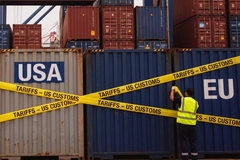
The European Parliament has approved the Turnberry agreement with the US, locking in 15% tariff rates on European beauty products entering the US. French cosmetics companies are warning that the duties are already hurting their biggest export market, while industry organizations respond by urging EU authorities to negotiate a beeline back to 0%.
Since the tariff turbulence last summer, French perfumes and cosmetic exports to the US dropped for the first time since the 2008 financial crisis, excluding the pandemic.
The US imposed a 15% tariff on EU goods in August 2025 as part of an initial handshake deal struck between US President Donald Trump and EU Commission President Ursula Von der Leyen at Trump’s golf resort in Turnberry, Scotland.
However, the EU delayed ratifying its side of the agreement for nearly a year, and the US responded by threatening higher tariffs if the deal was not finalized by July 4, 2026.
The rate temporarily eased to 10% in February amid trade negotiations. But, with Trump’s July deadline approaching, the EU Parliament gave in to approving the Turnberry agreement yesterday.
According to data from the French Ministry of Customs, the country’s perfumes and cosmetics exports to the US fell by 25% between Q4 2024 and Q4 2025.
French companies cut prices by around 20% to remain competitive in the American market, but the country’s customs says the lower prices did not lift them out of the trenches of the tariff dispute.
Following the finalized trade agreement yesterday, the French Federation of Beauty Companies (FEBEA) has raised alarms about the monetary implications of what it calls a “significant slowdown.”
“In total, the decline in French cosmetic exports to the US is estimated to have already resulted in nearly €800 million (US$928 million) in lost exports: €541 million (US$628 million) in 2025, plus an estimated €250 million (US$290 million) during the first half of 2026,” the association’s statement reads.
.webp) The European Parliament has cemented a 15% tariff on EU exports to the US, applying to cosmetics.“FEBEA understands the importance of placing the trade relationship between the European Union and the US within a stable contractual framework. However, this stability cannot come at the cost of a lasting increase in customs duties for a sector as exposed as the French cosmetics industry,” says Emmanuel Guichard, general delegate of the FEBEA.
The European Parliament has cemented a 15% tariff on EU exports to the US, applying to cosmetics.“FEBEA understands the importance of placing the trade relationship between the European Union and the US within a stable contractual framework. However, this stability cannot come at the cost of a lasting increase in customs duties for a sector as exposed as the French cosmetics industry,” says Emmanuel Guichard, general delegate of the FEBEA.
The association is calling on European authorities to “mobilize efforts to secure a return to a 0% customs duty rate for French cosmetics exported to the US.”
Tag-team T’s and C’s
According to FEBEA, the US remains the leading export market for French cosmetics, with €2.35 billion (US$2.72 billion) in exports in 2025. Moreover, France’s cosmetics sector funnels approximately US$45 billion in annual revenue into the country’s economy, ranking second only to aerospace in its contribution to the trade surplus.
Looking beyond the mounting losses FEBEA attributes to the trade talks, the European Parliament says its delay in sealing the deal with the US allowed it to negotiate several key safeguards for European businesses.
“Despite the pressure, Parliament stood its ground throughout these negotiations,” says Bernd Lange, chair of the International Trade Committee and standing rapporteur for the US.
.webp) EU lawmakers say the deal provides safeguards while maintaining stability in transatlantic trade.Referring to the finalized agreement, Lange maintains “it not only strengthens and stabilizes EU-US trade relations, but it also gives the EU the ability to respond if the US fails to uphold its side of the bargain.”
EU lawmakers say the deal provides safeguards while maintaining stability in transatlantic trade.Referring to the finalized agreement, Lange maintains “it not only strengthens and stabilizes EU-US trade relations, but it also gives the EU the ability to respond if the US fails to uphold its side of the bargain.”
Recovering lost momentum
A clause in the Turnberry agreement lets the EU suspend trade benefits for the US if Washington fails to address the EU’s concerns about tariffs.
The deal also includes a safeguard to protect European companies if US imports surge and cause serious business damage. Additionally, a “sunset clause” expires the agreement on December 31, 2029, unless it is renewed.
Despite this “safety net,” as Lange dubs it, he notes that the terms merely act as tools facilitating fairer trade, and that “political will” is needed for the trade partnership to be successful.
“If the US side breaches either the letter or the spirit of the Turnberry agreement, Parliament will insist that the Commission makes full and timely use of every instrument provided by this regulation and the wider EU toolkit,” he says.
“A stable and prosperous transatlantic partnership can only succeed if both sides remain committed to it.”
The beauty industry has closely watched Trump’s tariff talks unfurl, and industry alliances have been attempting to nudge parliamentary discussions in the sector’s favor.
For now, the 15% tariff looks like it is here to stay, and while FEBEA continues to push for a return to 0%, the beauty sector’s ability to recover lost export momentum may depend on future EU-US trade negotiations.