





Haut.AI SkinFM and SkinBench tackle false alarms in AI skin analysis

Key takeaways
- Haut.AI has launched SkinFM, a skin foundation model trained on more than four million images.
- Its SkinBench benchmark found six leading AI models flagged eye puffiness on clear skin.
- Haut.AI’s CEO says brands should test AI on clear skin before trusting its results.
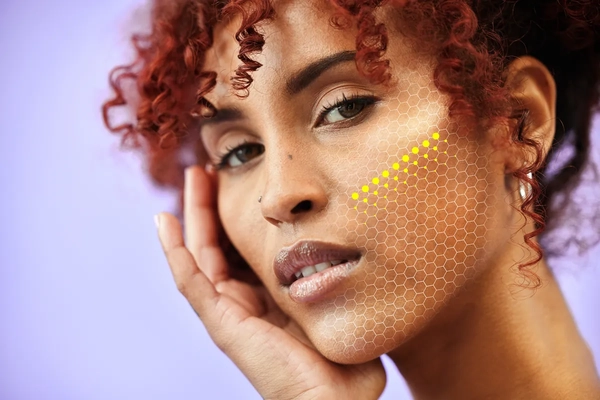
Haut.AI has unveiled its Skin Foundation Model (SkinFM), an image-based AI foundation model trained on over four million real skin images. It enables the company to develop customized skin measurements and analysis capabilities faster for beauty brands.
Alongside the launch, the SaaS technology company has released SkinBench, a public benchmark showing that six leading AI models, including models from Google, OpenAI, and Anthropic, frequently identify skin concerns that aren’t actually present or fail to detect concerns that are.
“A general-purpose model is built to describe an image, not to grade it against a reference, and it was probably never trained on the case that matters most in skin care: a face with nothing wrong,” Anastasia Georgievskaya, CEO and co-founder of Haut.AI, tells Personal Care Insights.
While popular AI models can recognize faces and describe visible features, the SkinBench results suggest they may struggle to assess skin accurately, potentially leading to inaccurate skin assessments and recommendations.
A Haut.AI survey of 1,238 US women has found that 62% are interested in or already use AI for skin care or body care advice, and half said they would trust AI for body care product recommendations.
“We developed SkinFM to make skin analysis more accurate and created SkinBench so the industry can see how different AI models actually perform,” says Georgievskaya.
One model, many measurements
Unlike traditional systems that need a separate model for each skin analysis task, SkinFM uses a single image-based foundation to analyze multiple skin characteristics. According to Haut.AI, this lets it develop new skin measurements faster and create grading systems tailored to individual brands. Beauty brands can then make more informed personalized recommendations, track visible improvements over time, and support research and product development, the company says.
Haut.AI’s technology can assess over 230 skin measurements and 48 biomarkers, including wrinkles, redness, pigmentation, and other visible skin characteristics. The company works with brands including Neutrogena, Beiersdorf, Ulta Beauty, and Grupo Boticário. Haut.AI says brands can sell on clear skin results.
The launch reflects a broader move toward AI built for specific industries and tasks. In April 2025, Gartner predicted that by 2027, organizations would use small, task-specific AI models at least three times as often as general-purpose large language models. Personal Care Insights previously reported on Haut.AI’s Skin.Chat skin care consultant and its Body Analysis tool.
Flagging false concerns
Haut.AI’s new public SkinBench evaluates models across 19 tests covering seven skin concerns and characteristics: wrinkles, sun spots, redness, skin tone, skin type, dark circles, and eye puffiness. Results are compared against reference assessments prepared by experts.
The six models tested were Gemini 3.5 Flash, GPT-5.6 Sol, Claude Fable 5, Grok 4.6, Qwen 3.8 27B, and Google’s medically specialized MedGemma 27B.
SkinBench identified that the six AI models incorrectly identified eye puffiness in approximately 95% to 100% of images where it was not present. The models also struggled to find wrinkles and identify skin types (such as dry, oily, or combination).
“Several of the models we tested marked puffiness on every image, including the 297 where trained graders found none. A perfect detection rate and almost no ability to recognize clear skin,” says Georgievskaya.
She explains that because these are closed models, Haut.AI can only infer how they were trained. She believes they most likely were not trained on expert grading, and there is “no solid science beneath the answers they give.” Georgievskaya says what they learned from is captions and conversations where a skin concern is mentioned, when it is present, and rarely when it is absent.
“They also answer the question they are asked. Ask whether puffiness is there, and the likely answer is yes.”
Additionally, the models struggled with wrinkles and skin types. When asked to mark frown lines on a face, SkinBench found that one leading model marked the nose and mouth instead, while another drew no lines on a test image.
In contrast, Haut.AI details that its model found 82% of deep forehead wrinkles, compared with 15%–60% for the other models. It scored 78% balanced accuracy, which weights each skin type equally, compared with 37%–58% for the rest.
Overall, Haut.AI’s technology scored 69.6 out of 100 on the SkinBench Skin Intelligence Score, a 0–100 measure of skin analysis accuracy and task completion, where 100 means perfect agreement with expert assessments on every image. Gemini 3.5 Flash was the highest-scoring general-purpose model at 50.6.
For brands already using general-purpose models, Georgievskaya recommends a simple check for each concern they make recommendations for. 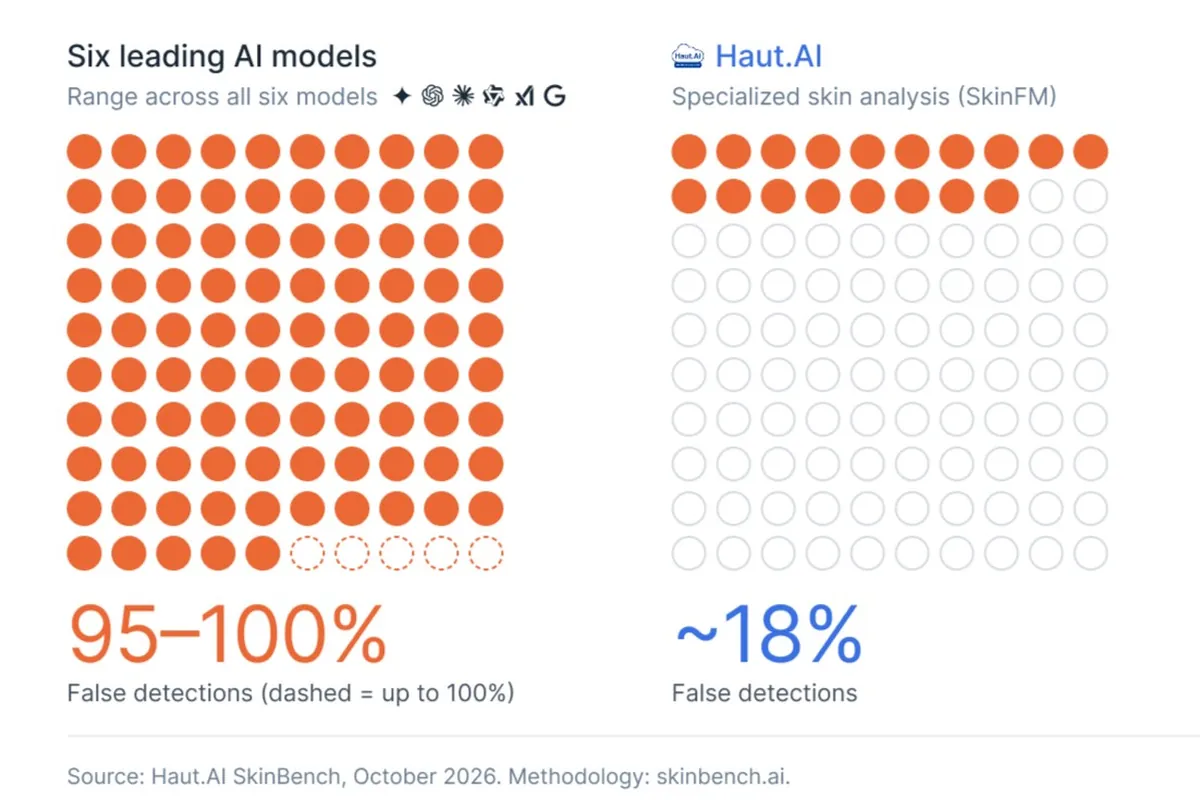 AI models flag eye puffiness on skin that has none.
“Take a few hundred images that trained graders have confirmed are clear of it, run your model on them, and count how often it flags something. Then look at your live positive rate. If most of your consumers are being told they have the concern, the model is confirming it, not measuring it.”
“No concern detected” is a result
False detections by AI skin analysis tools could lead to unnecessary product recommendations, but Georgievskaya rejects the idea that detecting more concerns automatically means selling more products.
“Whether a detection turns into a sale depends on the concern, the product range, and the recommendation strategy a brand chooses, and brands use very different ones,” she says.
Georgievskaya explains that Haut.AI’s recommendation system suggests a corrective product when a concern is present and preventative maintenance when it is not.
“‘No concern detected’ is a result in its own right, and a brand can sell on it.”
Recognizing clear skin is built into SkinBench’s classification metric rather than being scored separately, which is why a model that flags everything cannot score well.
Understanding inclusivity
Haut.AI scored 50.9 for performance across skin tones, compared with 30.3 for the next-best general-purpose model. Georgievskaya says the figure is deliberately conservative, as it reflects each model’s weakest-performing skin tone group for each task, not an average.
“A model is only as inclusive as the group it works worst for, and an average would hide that group. So the number is a floor, not a blended accuracy, and a floor is always lower”
She says that under-representation of darker skin in training data — the usual explanation for performance gaps — is not what Haut.AI sees in its own models. Georgievskaya suggests a more likely factor is the reference itself.
Some concerns are harder for graders to see on certain skin tones, making the ground truth less consistent for those groups. “On some tasks, a model underperforms on lighter skin, on others on darker skin,” she explains.
Before brands can promise consumers reliable results regardless of skin tone, Georgievskaya says the industry must adopt four standard practices: report performance for each skin tone group alongside the number of images behind it, use validation sets large enough in every group to produce reliable results, train graders on every skin tone group before they label images, and control exposure when capturing images.
“A false detection isn’t just a technical mistake. It can lead to inappropriate product recommendations, unnecessary purchases, and a loss of consumer trust,” says Georgievskaya.
Weighing a self-built benchmark
When asked how brands should weigh a benchmark built by a company that also tops its ranking, Georgievskaya says brands should focus on the scores for each skin parameter rather than the leaderboard position.  SkinBench publishes scores for each skin parameter.
“We publish how every model scored on each of the seven skin parameters, with the example images and the expert annotation next to each model’s output, and we say where we lose and to whom: Gemini, Claude, and Grok all score above us on skin tone.”
Gemini 3.5 Flash also outperformed Haut.AI on grading crow’s feet, scoring 71.7 against 61.8, according to the company.
However, Haut.AI is not offering third-party validation of the benchmark. Georgievskaya says the company uses open-source datasets alongside its own test data and plans to add new ones as they appear, but will not release its annotated data or its experts’ evaluation method.
“That is our own know-how,” she says, adding that Haut.AI publishes the methodology, sample size, and metric behind every leaderboard and will republish results whenever it releases a major new model version.
Haut.AI also plans to expand SkinBench with more AI models and new tests that examine whether models produce consistent results when analyzing the same skin concerns.