





Commodity costs divide Unilever and Beiersdorf on beauty pricing in Q3

Key takeaways
- Unilever raised prices by 2.3% to cover higher commodity costs and still sold more products.
- Beiersdorf is keeping Nivea’s prices steady as cheaper local, Korean, and private label brands take share.
- Premium, science-led skin care is driving growth at both companies, with Beiersdorf’s Derma business up 10.6%.
Unilever and Beiersdorf’s respective Q3 2026 financial results reveal opposite approaches to pricing as the multinational consumer goods giants navigate rising commodity costs.
Unilever raised its prices across its beauty, personal care, and home care divisions, but has reported selling more products despite higher price tags. Beiersdorf, meanwhile, is staying out of price hikes and looking to win back shoppers for Nivea, the company’s largest brand.
Unilever raised its prices across its beauty, personal care, and home care divisions, but has reported selling more products despite higher price tags. Beiersdorf, meanwhile, is staying out of price hikes and looking to win back shoppers for Nivea, the company’s largest brand.
“We are not losing market share against the other big companies that you are following. We are losing market share against local brands, against Korean brands, local private labels, which are cheaper than us,” Beiersdorf CEO Vincent Warnery said during the company’s earnings call yesterday.
For the third quarter of 2026 (July to September), Beiersdorf’s group net sales reached €2.4 billion (US$2.7 billion), down 1.3% organically, as Nivea sales fell 4.9%.
“Every additional cent, every additional euro, consumer price impacts the value for money positioning of Nivea. This is why we are extremely cautious,” Warnery emphasized.
For the same period, Unilever posted 5.2% underlying sales growth, with 2.9% coming from volume and 2.3% from price. The group’s turnover reached €13.3 billion (US$14.9 billion), up 6.7% from last year.
“We have delivered another quarter of competitive growth, led by continued strong volume delivery and a step up in price to offset the impact of higher commodity costs,” says Fernando Fernandez, CEO at Unilever.
Despite their splitting paths, both companies share the same growth lever: premium, science-led skin care. Beiersdorf’s Derma business, which contains the Eucerin and Aquaphor brands, grew 10.6%. Meanwhile, Unilever’s premium innovations across its Power Brands and prestige beauty portfolio drove the group’s growth.
.webp) Beiersdorf says there was no price effect in Nivea’s Q3 results, so its growth and declines came from volume alone. Betting on claims for cash?
For Beiersdorf’s Q3, Nivea sales came in at €1.26 billion (US$1.41 billion), down 4.9% organically from the same period last year. The company cites temporary sell-in headwinds, including trading tensions and retailers cutting back on stocks, but expects these will fade by the end of the year.
Beiersdorf says there was no price effect in Nivea’s Q3 results, so its growth and declines came from volume alone. The brand’s sell-out continued to grow globally, but CEO Warnery said on the call that it is growing slower than the rest of the market. The company is betting on retailer support to help drive growth in the upcoming quarters.
“We clearly want to give more products to more consumers, and it means we need to have the support of retailers, and we also have to offer products at the right price,” he said, adding, “We are not willing to increase price.”
Warnery later said that the group “clearly sees the opportunity” to do a price increase, but only if “there is a real consumer benefit that we are able to explain.” He pointed toward new technologies or claims as possibilities.
The company expects gross margin pressures to carry into 2027 due to higher commodity and logistics costs. In the next year, Warnery plans to execute a restrained pricing policy and hopes to offset the higher costs by selling more units.
The pricing decisions are tailored to Nivea’s competitors. Warnery has said that the brand is losing share to cheaper brands and highlighted K-beauty.
South Korea’s cosmetics exports rose nearly 20% in Q1 2026, and global retailers continue to push the products onto shelves. For a mass market brand like Nivea, a price increase pits it directly against these options.
Instead, the company is betting on an 18-month turnaround plan, first announced during its half-year results. The plan focuses on new launches across all categories, stronger value for money, and more locally relevant products.
Its hero launch for Europe is Face+, a low-priced face care line, and Warnery said it is “showing positive early traction.”
.webp)
Unilever raised prices across its beauty, personal care, and home care brands while still growing volumes.
Unilever raised prices pay
Unilever has stepped up its prices in Home Care by 3.6% and in Personal Care by 2.4%, and added 2.1% in Beauty & Wellbeing. Despite these upticks, the company reports its volumes grew 5.4% in Home Care, 3.8% in Personal Care, and 3.6% in Beauty & Wellbeing.
Combined, the three divisions grew 7%, 4.1% of which is volume. Unilever says its Power Brands led the way, growing 5.8% with 3.3% from volume. Dove, Vaseline, Sunsilk, Clear, and K18 all posted double-digit growth, led by volume.
The results suggest that Unilever’s Desire at Scale strategy, which aims to make everyday brands feel premium and aspirational, is giving it room to raise prices. Personal Care Insights previously reported how the strategy lifted the company’s beauty volumes to a record decade-high in H1.
Despite the gains, the pricing adjustments did not land evenly. Unilever’s emerging markets did most of the heavy lifting, growing 9.5% with 6% from volume, led by 15% growth in India.
Meanwhile, developed markets declined 0.9%, with volumes down 1.7%. In Europe, sales fell 1.7%, and prices dropped 1.3%, revealing that Unilever’s pricing advantage is strongest outside the region where Nivea is fighting its hardest.
Unilever upgraded its outlook and now expects at least 3% volume growth for 2026 and underlying sales growth in the 4% to 6% range. The company also expects higher commodity costs to drive faster pricing in Home Care for the rest of the year.
.webp)
Beiersdorf is keeping Nivea’s prices steady to compete with cheaper rivals.
Science sells at a premium
Unilever’s premium push also shows up in its results. The company’s premium Dove innovations in hair serums, masks, and scalp care helped drive growth for the hair care division. Meanwhile, prestige brands such as Paula’s Choice and Hourglass helped fuel skin care.
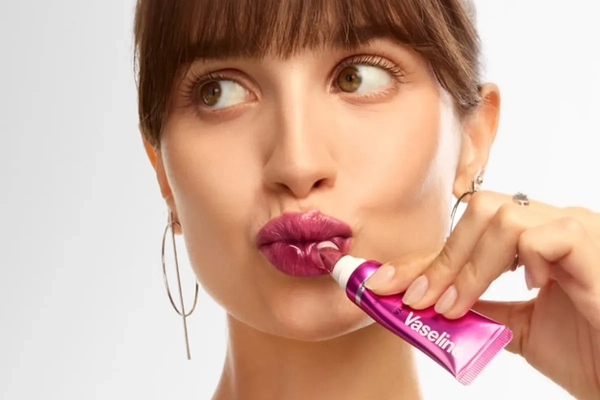
The company has also revamped its Vaseline brand with science-led ingredients that aim to give the heritage brand a more premium feel.
At Beiersdorf, Derma sales grew 10.6% to €401 million (US$449 million). Warnery highlights Aquaphor and Eucerin as standout brands in the division that “once again outperformed the market.”
“We continue to see strong growth across regions and categories, supported by our expansion into white spaces and the rollout of breakthrough innovations,” said Warnery.
“In Latin America, Mexico and Brazil continued to drive growth … and across the Africa, Asia, and Australia region, Eucerin continued to deliver double-digit growth of 25%, with particularly strong performance in Thailand and China.”
On the call, Warnery explained that Beiersdorf is navigating a split market where mass shoppers want value for money, while premium, science-backed skin care keeps growing in pharmacies, drug stores, and department stores.
The trend has reached beyond these two companies. L’Oréal’s Dermatological Beauty division, which contains the CeraVe and LaRoche-Posay brands, grew 11.6% over the first nine months of 2026.
For brands like Nivea, caught in the middle of accessible pricing and demand for premium, the challenge is to compete without losing the trust that keeps shoppers coming back.