



Human cervix chip model advances personal care research without animal testing
The technology from the US is said to be an industry first

Key takeaways
- The world’s first human cervix organ-on-chip enables real-time monitoring of vaginal and cervical cells.
- The chip offers the cosmetics industry a model to evaluate product effects on mucosal tissues, microbiome interactions, and barrier integrity in intimate care formulations.
- The technology supports broader adoption for skin testing, offering reproducible data that could align with global regulatory trends toward human-based safety testing.

The world’s first cervix organ-on-chip model has been developed, enabling the real-time monitoring of cervicovaginal cell responses. This breakthrough could be used to test or develop new intimate care products in the future.
The cervix chip model is currently one of the closest laboratory models of the human cervix. Its “human-relevant platform” can assess the safety of new personal care products — testing their toxicity and effects on the structure, function, and health of female genital mucosal tissue.
The technology, designed by Dr. Zohreh Izadifar and the multidisciplinary teams of Biosensing, Microfluidics, and Microsystems, and Female Reproductive Health from the Wyss Institute of Harvard University, US, is positioned as a “world-first” in human-based safety testing without the use of animal testing.
Izadifar tells Personal Care Insights that the chips have been designed to “provide more human-relevant responses than animal models or overly simplified cell culture systems.”
These models can be used to assess how products affect mucus production, inflammation, tissue health, and barrier function, helping identify formulations that may cause irritation, discomfort, or increased susceptibility to infection.
Replicating human cervical mucosa
According to Izadifar, the cervix chip model replicates several key features of the human cervical mucosa. These include a three-dimensional cervical tissue structure with a tight barrier; mucus production that coats the cervix and vaginal wall; hormone-driven tissue changes across the menstrual cycle; and stable interactions with the beneficial bacteria of the lower reproductive tract.
 Dr. Zohreh Izadifar received £50,000 (US$67,300) to advance this platform, part of a £250,000 (US$336,600) fund supporting global efforts to end animal testing.Izadifar tells us that these biological properties are essential for maintaining normal and stable cervix and vaginal function throughout a woman’s life and in response to pathological challenges.
The cervix chip also closely mimics damage to the cervical epithelium integrity and function when exposed to opportunistic bacteria associated with adverse reproductive health outcomes in women.
“The design and development of new personal care products must ensure that they do not damage, disrupt, or compromise the natural dynamics and protective properties of the female urogenital environment,” says Izadifar.
“Animal testing is not ideal for this purpose because animals do not share many important aspects of human reproductive biology; they do not menstruate, do not undergo the same hormonal changes as humans, and have very different microbiomes and immune responses. As a result, safety findings from animal studies often do not fully translate to humans.”
Izadifar also contributed to another similar innovation, the vagina chip.
Ingredients used in intimate skin care products can be tested in these models — the cervix chip and the vagina chip — to evaluate how they interact with and affect the function, composition, and integrity of lower reproductive tract mucosal tissues.
For example, these models can provide data on how product ingredients influence mucosal barrier integrity, the composition and stability of the protective mucus layer, and the viability or stability of beneficial bacteria in the lower genital tract. According to Izadifar, these insights can “help guide formulation changes to improve both product safety and efficacy.”
Improving future safety of intimate products
Conventional testing models, particularly animal models, often have immune responses that differ substantially from those of humans. As a result, product safety and comfort data generated in animals can be misleading when translated to human use.
Izadifar explains: “A product that appears safe and non-irritating in animals may still trigger immune activation, inflammation, discomfort, or disruption of the natural microenvironment in human genital tissues, especially in sensitive individuals.”
Additionally, the reproductive tract microbiome plays a central role in maintaining a balanced and protective genital environment. Organ-on-chip models can recreate host–microbiome interactions in both healthy and diseased states. This makes it possible to study how products interact not only with host tissues but also with resident microbial communities, providing valuable insight into product tolerability and performance.
These models could be used to test lubricants, moisturizers, cleansers, contraceptive products, and other intimate-care formulations with improved prediction of human responses.
New approach methodologies
In recent years, there has been growing momentum and multiple initiatives from regulatory agencies worldwide to increase the use of human-based new approach methodologies (NAMs) in preclinical testing, particularly for safety assessment.
For Izadifar, organ-on-chip technology is “one of the most promising NAM platforms and is actively being explored and validated for regulatory and safety-compliance applications.”
She says: “The cervix chip and vagina chip models have strong potential for toxicity and safety testing of cosmetics and personal care products. Although this application has not yet been extensively developed, the timing is favorable for exploring human-based genital organ chips as regulatory support tools for intimate-care products.”
To achieve this, Izadifar says the models must be rigorously tested and validated using products with well-characterized human safety and toxicity data. This validation process would allow the models to be qualified for specific contexts of use and to generate reliable evidence that can support regulatory safety claims.
Use beyond vaginal or cervical applications
According to Izadifar, organ chip models of other mucosal tissues — including skin-on-a-chip and oral mucosa-on-a-chip — have already been adopted in research and early-stage development for irritation testing, absorption studies, and safety assessment. However, large-scale commercial and industry adoption is still emerging.
Following the 2013 ban on animal testing for cosmetics in Europe, interest in human in vitro skin models expanded significantly.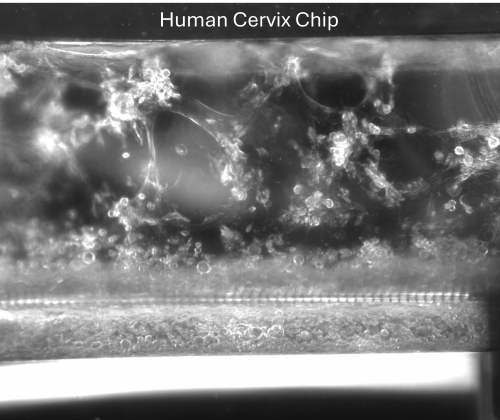 A microscopic image of the side view of the cervix chip that shows the cervix epithelium-stroma interface (on the opposite sides of the white dashed line) and secreted mucus in the epithelium lumen (upper side of the dashed line).
Reconstructed skin models based on static cell cultures have grown substantially, and several commercial systems are now used for cosmetic safety testing. Skin-on-a-chip has further advanced this field by incorporating dynamic physiological features such as vascularization and mechanical stretching. These improvements allow for more realistic evaluation of skin care product safety, toxicity, and efficacy, including sunscreens, cosmetics, moisturizers, and anti-aging products.
“Oral mucosa-on-a-chip is another example of a mucosal model that has been applied in dental and oral health research. It can be used to test materials and formulations in products such as toothpaste, mouthwash, and oral moisturizers to assess safety, tissue irritation, and host responses,” says Izadifar.
“Together, these platforms have the potential to transform how personal care products are developed and evaluated across a wide range of skin and mucosal applications.”
“As an academic institution, we have limited capacity to provide routine testing services for product development. However, we are interested in collaborative partnerships focused on testing and validating chip models for specific applications.”
Izadifar says such collaborations could “help accelerate the integration of human-based chip models into product development pipelines for safety, toxicity, and efficacy testing.”