



TRAFFIC tackles beauty’s wild-harvest sourcing risks with framework


Key takeaways
- TRAFFIC and Biodiversify’s WHIP Framework offers beauty companies a practical route to improve wild-harvested ingredient sourcing before certification.
- Pilots in Morocco and Uzbekistan exposed traceability gaps, intermediary dependence, and risks around argan and licorice harvesting.
- Sustainable wild harvesting can protect biodiversity while supporting rural livelihoods, local governance, and more resilient beauty supply chains.
TRAFFIC (Trade Record Analysis of Flora and Fauna in Commerce) and Biodiversify have launched the Wild Harvest Improvement Project (WHIP) Framework to improve the sustainability of wild-harvested feedstocks, also used in personal care formulations.
WHIP aims to empower communities and businesses to pursue regenerative alternatives in their supply chains by offering them a pragmatic route toward sustainability certification.
Personal Care Insights speaks to Cara Flowers, sustainable supply chain manager at TRAFFIC, about the importance of wild-harvested ingredient preservation for the beauty industry and the cascading impacts of protection on people and planet.
The framework was piloted in Morocco and Uzbekistan for argan and licorice harvesting, respectively. The two ingredients are often utilized in applications ranging from oral hygiene products to hair and skin care. We discuss the Morocco and Uzbekistan pilots with Flowers and the findings’ significance of wild-harvest sustainability and local economic empowerment.
“The approach is particularly relevant for cosmetics because many companies source relatively small volumes of botanicals but face significant biodiversity, human rights, and reputational risks associated with those ingredients,” she says.
“WHIPs offer a practical route for companies to engage before certification is feasible, while making demonstrable improvements in biodiversity protection, community benefits, and responsible sourcing.”
TRAFFIC is a non-governmental organization (NGO) specializing in the protection of wild plants and animals, and launched WHIP in partnership with British conservation consultancy Biodiversify.
The framework was developed through a partnership featuring TRAFFIC, the Global Diversity Foundation, Biodiversify, Moroccan Biodiversity and Livelihoods Association, and FairWild, and was funded by the UK Government through the Darwin Initiative.

Wild-harvested botanicals are widely used across beauty and personal care formulations.
Beauty supplies and wild harvests
Flowers tells us that the WHIP framework was specifically designed to improve many of the issues that characterize cosmetic ingredient supply chains. She names fragmented sourcing networks, multiple intermediaries, limited traceability, and weak visibility of conditions at the harvest level as typical challenges across ingredient supply chains.
“Rather than relying solely on end-point certification, WHIPs create a structured, multi-stakeholder improvement process that brings together harvesters, communities, traders, processors, brands, NGOs, and government authorities around a shared improvement plan,” she says.
She tells us that for cosmetic ingredients such as argan oil, the pilot in Morocco’s argan harvests showed how value chains can become “increasingly opaque” as intermediaries and multinational buyers extend power over raw material access.
“Cooperatives often no longer know precisely where all harvested material originates and struggle to secure direct access to fruit,” she says.
“Similarly, the Uzbekistan licorice pilot found that processors frequently purchase through intermediaries, making it difficult to identify harvest locations, harvesters, and compliance with harvest limits.”
Making sustainability attainable
WHIP’s approach aims to provide a structural apparatus to make sustainability accessible before the point of achieving certification.
According to Flowers, WHIP aids in mapping supply chains and stakeholders, establishing baseline assessments, and strengthening traceability systems. Additionally, the framework develops collective action plans, defines measurable environmental and social indicators, and creates transparent reporting and verification processes.
The accessibility of sustainability without the need to already have received certain certifications lowers the threshold of what harvesters and businesses can participate in regenerative practices across the value chain.
“Certification should not be the starting line. Certification should not even be the destination, but instead part of continuous and incremental improvement,” says Flowers.
“WHIPs are therefore intended to make the pathway to sustainability accessible to a broader range of producers, including small cooperatives and harvesting communities that may otherwise be excluded from formal certification processes.”

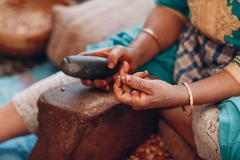
Argan harvesting supports biodiversity and rural livelihoods for Moroccan women.
The intersections of preservation
Flowers emphasizes that sustainability in wild harvesting has a series of effects that transcend maintaining access to raw materials alone. The beauty industry has an intertwined relationship with harvest fortitudes. Irresponsible harvesting caused by the industry can negatively impact crops, whereas scarce crops can cause long-term strain on beauty supply chains.
However, Flowers stresses that the beauty industry abandoning wild sourcing entirely can have unintended consequences on livelihoods and the environment.
“Many wild plant species support entire ecosystems and provide critical income for rural communities,” says Flowers.
The Morocco pilot highlights this dynamic through argan.
“Argan forests support more than 1,200 plant and animal species, including many endemic species, while also providing protection against desertification, reducing soil erosion, improving water retention, and supporting rural livelihoods,” Flowers tells us.
She says that argan is also culturally and economically important as “women’s cooperatives generate employment, income, literacy opportunities, and greater economic independence for rural women.”
Similarly, Flowers says that the licorice pilot showed that the sector provides employment opportunities in remote parts of Karakalpakstan, an autonomous republic of Uzbekistan, where alternative livelihoods are limited.
The WHIP Framework aims to strengthen sustainability across wild ingredient supply chains.
“Interviewees repeatedly identified licorice cultivation and processing as an important source of income and employment in a region facing high unemployment,” she says.
Self-preserving wild harvests
Meanwhile, several of the ingredients are vastly beneficial to the environment as they aid in wider ecosystem reinfocement. Flowers underlines that licorice supports pollinators, fixes nitrogen naturally, and can contribute to soil stabilization.
“The pilots showed that sustainable sourcing is not just about protecting a species. It is about protecting ecosystems, strengthening local governance, improving livelihoods, and creating supply chains in which the communities stewarding these resources share fairly in the value they create,” says Flowers.
“Sustainability in wild harvesting is not achieved by walking away from these supply chains. The people who know these species best are the people harvesting them, and they need a route that recognizes the progress they are already making. A WHIP ensures these species remain a critical part of their ecosystems while helping the people who harvest them earn a dignified living. That is a commercial argument as much as a conservation one.”