

Iridescent promotional banner from Kao Chemicals Europe featuring “Pearled Perfection,” advertising Danox Pearl GS with soft pastel swirls and a “Learn more” button
Home
Webinars
What’s trending in c...

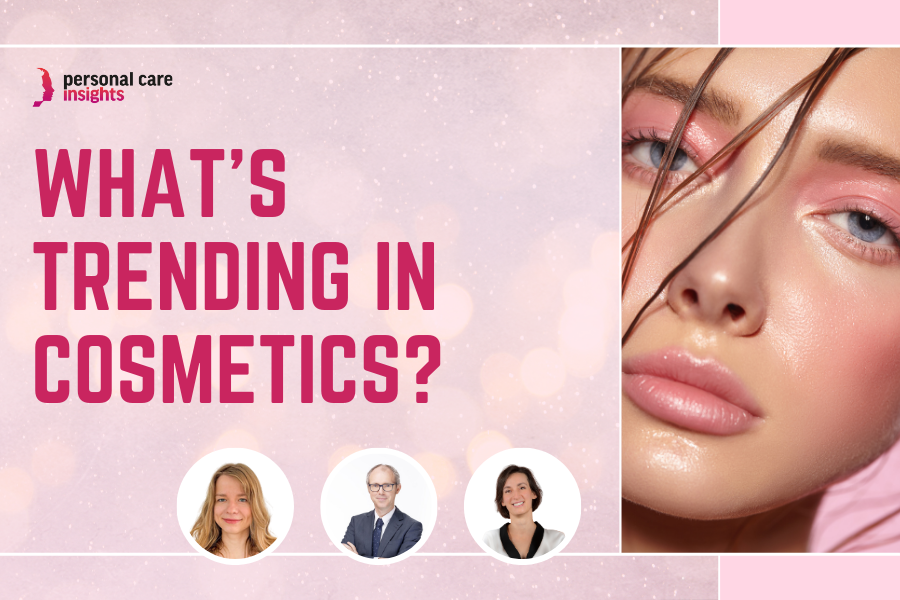
What’s trending in cosmetics? A deep dive into the booming beauty industry

08 May 2024 | Personal Care Insights
Video Background

The cosmetics industry is ever-evolving amid changes in regulation and consumer preferences. Key trends continue to impact the beauty sector, including sustainability and biotech innovations, health and well-being, plus ingredient innovations to ensure optimal product performance.

Current market research suggests the sector is poised to cross US$100 billion in revenue within three years. Regulators are keen to update the playbook for industry players amid scores of companies crusading to capture consumers in this massive market.

In this webinar, industry experts will debate current market trends, obstacles and solutions to help companies excel in this dynamic space. Join us to learn more about how you and your company can navigate, adapt and succeed in the personal care and beauty industry.

Hello and welcome to today's webinar where we are about to explore what's trending in the cosmetics industry.

The sector is back in full swing after the pandemic, which means a renewed desire to put your best face forward.

How are companies responding to this?

Sustainability is definitely an ever evolving theme.

At the recent In Cosmetics Global trade show in Paris, France, most innovations had sustainability claims.

Consumers also seem to be increasingly conscious of planetary and human health, driving demand higher.

I'm Anita Sharma, editor of Personal Care.

Insights and industry leading news and insights platform.

I'm very pleased to be joined today by our expert speakers, Marie Olegni, CSR director at SEPIC, as as Doctor Mark Smith, Director General at Narue.

We're all fresh off the In Cosmetics trade show, so we have a lot to discuss.

First though, let's start with a presentation from CNS Media marketing analyst Laura Studente, who will share some key highlights based on Enova Market Insights data.

Take it away, Laura.

Thank you, Anita.

Hello everyone.

Today we will take a closer look into the market and consumer insights for global cosmetics, skincare and haircare launches, and these insights are powered by our data technology partner in our market insights.

First, let's look into the top personal care trends for 2024, which are identified by normal market insights, and there are two trends that we were particularly look into, which is precision and performance, which is a top one trend, and seeking sustainability.

But as you can already see in this trend.

Wheel other aspects are also on trend.

For example, preferences for anti-aging benefits care for the skin barrier, which is more skin health connected.

But there are also general trends like celebrity individuality and diversity and also emphasis on brand and consumer communication.

But before diving into specific trends, let's look at the growth of launches after the global pandemic, and here we can see a gradual recovery post lockdown restrictions, with an average annual growth of 2% in new cosmetics, skincare and haircare launches in the last 3 years.

Notably, we can also see growth in cosmetics as subcategories like body cosmetics, face concealers, and facial body bronzers, and these are experiencing significant growth post pandemic.

And now we can look into the share of NPD in the global region.

It's noteworthy that Europe accounts for over half of these launches, and we can also see this example of a lipstick where you can see that the beneficial ingredients are emphasized, for example, caramites, and no doubt caramites can also be noted as a trending ingredient for Beauty World in 2024.

And now let's examine the top claims for global launches across various subcategories.

Moisturizing and hydrating is the leading claim, and this reflects consumers' interest in beauty and personal care products that provide caring benefits.

And looking at that, it also correlates with consumers' interest in skincare infused beauty products, and that just means that consumers are seeking products that have multiple benefits.

For example, a moisturizing foundation.

There is also a long lasting claim that correlates to consumer needs of functional and effective products, and you can also point out how animal-free innovation products are rising, how leading they are.

And you can also see this example from Fenty Beauty.

This is a concealer that basically has it all, it's moisturizing, it's long-lasting, and also Fenty Beauty positions itself as a cruelty-free brand, so it encapsulates the trends.

But you can also see another influential trend for 2024, which is celebrity and influencer led beauty brands that are also gaining traction.

And now let's take a closer look at trends.

Consumer insights reveal a strong emphasis on functionality and convenience in makeup purchases, and approximately 2/3 of consumers globally prioritize convenience and ease of use when buying makeup.

And also functionality is a key consideration for 59% consumers when they purchase skincare.

And this underscores the demand for multifunctional products, and that aligns with the beauty minimalism trend.

This means that instead of 5 products with different types of functions and efficiency, consumers would then seek for one product that has multiple benefits, which is no doubt also more sustainable and aligns with the beauty minimalism.

And this of course leads us to our last topic, sustainability, and this is a growing concern among consumers worldwide how do consumers globally express environmental concerns that are very important for them when they're choosing beauty products.

And this also correlates with the market growth because ethical claims have grown 27%.

And that also proves the trust in sustainability claims.

And also I have to note that packaging also plays a very important part in the sustainability claim, as consumers know that sustainable packaging indeed is very important for them and in all market interests have pinpointed that a lot of consumers.

Also tend to choose a packaging that's not only sustainable but also aesthetically pleasing.

So in this case this also aligns with sort of multifunctional kind of aspect that product could be both sustainable, aesthetically pleasing, easy to use, and effective, which consumers are now seeking to.

And that's all for now for this market insights.

Thank you for your attention.

Thanks very much, Laura.

Very, very insightful.

All right.

It is time to bring in Marie Olegnier, CSR Director at SEPIC, as as Doctor Mark Smith, Director General at NITRU.

Welcome to Personal Care Insights.

Thank you, welcome.

Thank you very much.

Thanks, Marie.

Let's start with you.

You spoke at the In Cosmetics event in Paris.

What did you discover there?

How was your experience?

So consumers are looking for products with reduced negative impact on the people and the planet.

This consumer demand is particularly strong in Europe, associated with the increasing regulatory demand.

Sustainability became a critical requirement.

From European and multinational cosmetic companies.

In Cosmetics in Paris, we could see that almost all new products highlighted showed a high naturality profile or sustainability labels or even good traceability.

All right, very interesting.

Mark, let's bring you in now.

Great to see you, after, such a spectacular event.

Like I said, you spoke there as.

Your thoughts on the trade show and what you saw with respect to sustainability?

Yeah, I guess because we are er naturally has a private standard for natural and organic cosmetics, we're always focusing on exactly the points that Marie's just mentioned about essentially the naturality, the validation for some of the claims rather when it comes to the efficacy, but particularly the origin of the raw materials and their sustainable profile and environmental footprint.

And increasingly at the trade show, I've been to in Cosmetics for a number of years now, but there's certainly been a gravitational shift.

Towards raw materials which are more and more focused on their naturality, but increasingly and particularly this year, the emphasis was really on the sustainable profile of a lot of the raw materials.

Natural was kind of, basically the established business precedent, let's say, but the focus was really on sustainability and the footprint of these raw materials.

And that was.

That's great.

Thanks, Mark.

Marie, let's talk about this theme.

Let's just dive, deeper into it if we can.

Is this important for your clients?

How does this impact your caring program?

Yeah, so as Mark said, sustainability is really becoming a key word, and the high expectation from cosmetic manufacturers and consumers on sustainability has been a driving force for the development of CEPIC sustainability strategy, caring.

And the deployment of our programs for climate and biodiversity.

Our constant efforts and continuous improvement enable us to renew our Ecodermadis platinum status in 2023.

And it also has been taken into account when we decided to change our brand identity.

At CEPIC we are convinced that we regularly have to evolve and align our image and our brand with our values and who we are.

That's why our logo and signature have changed.

Our new slogan, SEPIC Science That Cares, refers not only to our committed and responsible innovation, but also to our scientific know-how.

Science conveys a notion of passion, rigor, and exacting standards that are part of our values, part of our culture.

The that cares part refers to our ethical commitment and to the attention we pay to the environment surrounding us, the men and women, and the planet.

Very good.

Thank you, Marie.

Mark, I'd like to shift to another topic as , a big one for our website with respect to our readership.

So I'm not surprised it's also an audience question.

It concerns animal-free innovations.

I spoke with a member of your team who does R&D for Veda.

He said it was lonely in the beginning, but thankfully there are more players in this space now.

What are your thoughts?

If you look at, animal testing, yes, certainly, if any time we've done, either a survey internally or asked any type of consumer, it's one of the top things on their list, is basically this, avoiding animal testing.

But of course there is a case that at least under EU law, animal testing is banned.

And in fact 20 years this year, there was the first ban on testing on finished products.

So although it remains high on consumers' interest, there is also a legal basis to of course require any finished product to not be tested on animals.

And in this is also increasingly becoming worldwide with recently countries such as Canada and Chile following suit.

Yeah, definitely, huge news, to kick off this past year, 2024.

Marie, let's talk a little bit if we can about biodiversity.

We also have a question, from our audience with respect to this theme.

Can you explain a little bit, possibly about the challenges companies face in this area?

As you may know, we are facing an alarming biodiversity decline, and the scientific community is alerting us through the publication of several reports.

If we look at figures, 75% of land and 2/3 of marine environments are altered by human activities.

There are, if you consider biodiversity, there are 5 main pressures on biodiversity that we consider.

You have land degradation, climate change, pollution, overexploitation of biological resources, and the invasive exotic species, and every company has a role to play.

Consumers are more and more attentive to these commitments.

At SEPIC, we worked with an external consultant and run a biodiversity footprint assessment, of our impacts on biodiversity and how we can limit these impacts on biodiversity.

That's how we have created our biodiversity program called RISCE.

So in rice you have reduce, integrate, control, and engage.

Today at CEI, more than 50% of our raw materials portfolio is bio-based.

So the first pillar and the critical one is Reduce, so reduce the pressure generated by our supplies on biodiversity, and we work on that by improving and making sure we have sustainable sourcing validated by certification and labels.

The second pillar is integrate biodiversity in our industrial processes and our facilities, and it's done by working on optimization of energy efficacy, renewable energy, working on water and waste management, but also site environment management.

The third pillar is control.

It's about controlling the product impact through their life cycle, and it's done with an eco-design approach that we have implemented in our research and innovation process to develop new ingredients.

And the final one is engage.

It's about engaging and supporting our stakeholders in favor of biodiversity, for instance, our suppliers, because we need a collective commitment to improve and reduce our impacts on biodiversity, but also with projects in the field.

That's excellent, Marie.

Thank you.

Mark, it really is all about engagement, isn't it, at the end of the day.

Yeah, absolutely.

From the perspective of, let's take the, the consumer and the consumer engagement, this main point about identifying, transparency throughout the supply chain and key metrics are important in the decision making, because of course a consumer not only wants to have a product which is safe and efficacious, but at the end of the day.

They also want to have the product which ticks a num ticks a number of other boxes, principally those, as we've talked about earlier, focused around sustainability and with increasing like sensitivity towards, aspects which are more complex, which Marie has talked about, which focus on like, let's say biodiversity and the, and the general impact of the cosmetics industry upon you know, the global biodiversity network.

So yeah, there's absolutely a case for that, and I think the transition towards that is something that we as an association embrace, but a lot of manufacturers are embracing.

There's obviously a change in a lot of the regulatory framework that's happening in Europe to align very with this through the European Green Deal.

But, but yeah, it's, it's a, it's a, it's a both a sort of positive challenge and also a complicated area at the same time.

Yeah, dynamic, for sure.

In Laura's, great presentation, we did learn, just staying with the Europe theme for a second, we learned that Europe leads with respect to product launch activity.

Europe, as you mentioned, Mark, also dominant with regulations.

You have a chemist background.

How do you see these regulations influencing formulations, innovations, and relationships within this industry?

Yeah, yeah, I guess the, the, the, the main thing with any type of regulatory modification is the impact if you think from innovation upon the palate of available raw materials.

And you know, we see through aspects like there's the targeted revision of the cosmetics regulation, there's the revision of, CLP, basically through alignment of both pieces of legislation to, the chemical strategy for sustainability here in Europe.

There's also a suite of other pieces of, of, of comparative.

Legislation which are more horizontal in their application to do with either greenwashing directives, with the revision of the unfair commercial Practices Directive or a specific green claims directive that invariably have some kind of impact upon the capacity of manufacturers to be able to make decisions when sourcing particular raw materials.

Because it will either impact their particular selection of raw materials based upon what is let's say, considered safe through to the type of claims that they can make, particularly if they're looking in the future to make more environmental claims and how they substantiate.

Those claims, particularly as the aspect of most of the, sort of movement of traffic of some of these legislative files are associated with third party certification and substantiation of sustainability labels or claims.

Yeah, great information there.

Thank you, Mark.

Marie, your thoughts on this because I would imagine, with SEPIC, you deal with this firsthand as.

Yeah, and so Mark mentioned the Green Deal regulation, and as part of the Green Deal, Europe defined in 2022 a framework called safe and sustainable by design which aims at ensuring the development of substances and materials safe and sustainable and in alignment with this.

Frameworks if we develop a proprietary ecodesign approach which takes into consideration the impact of raw materials, our operations, and the end of life of our products under development in order to reduce these impacts as much as possible from the early stage.

The goal for us is to find the best balance between environmental, technical, and economic requirements.

As of 2024, all innovations launched by SEPIC will be eco-designed.

All right.

Very, very interesting.

Mark, let's go back to you.

We know, and I talked about this extensively, with various suppliers, manufacturers at the trade show, in Paris.

We know that efficacy and functionality, for example, hair shine ingredients, From Dow and SEPI.

I know Marie will talk about SEPI in a second.

We know that this still reigns supreme.

We know that consumers want to make sure that the product they purchase stands by its claims.

How do you reconcile this, wanting to stay sustainable, but also as a consumer, making sure that your product works.

Yeah, I, I guess there's a partition of er let's say regulatory compliance in this aspect.

So if we look at er general efficacy, these will be covered by not only product claims in Article 20 but a companion piece of legislation to the European cosmetics regulation to do with common criteria for product claims.

So this will establish a basis for evidential support in order to say.

Something like about let's say the efficacy of a particular hair care product or something like this or it's certain functionality.

If we look at environmental claims, these are not really falling under the scope of the cosmetics regulation because that's more focused on human health.

So these will be more sort of let's say fall under the scope of more horizontal pieces of legislation, particularly those to do with these various greenwashing directives that I've mentioned before.

So in those cases, yes, it will be a balancing act, but there will also be a case where if you're wanting to make a cosmetic product, first and foremost, the case is to make it safe and efficacious.

The other claims are add-ons which are have certainly have added value for for people on the planet.

But are things which you just have to be mindful of when you're sourcing particular raw materials, before, and then also with a view on the end of the environmental fate and end of life of raw materials.

So effectively what manufacturers are having to do is to look at more of a holistic approach, a kind of end to end approach, in the way that they are basically constructing their research and innovation in the future.

So it won't just be.

Falling directly under the scope of the cosmetics regulation, there will be lot more pieces of legislation that will basically be required either to meet simple regulatory compliance or consumer expectations.

Excellent.

Thank you, Mark.

Marie, we know that, whether it's, demands from regulators or consumers that inevitably leads to innovation, and we know that SEPI definitely answered the call there.

What do you think about that?

Yes, it's true.

And as Mark says, on one hand, we can reconcile sustainability, efficacy, and trust with claims that are verifiable and proven, supported by tests, norms, and certifications.

This is aligned with the most recent regulation and at CEPI we developed a communication charter as a framework with rules to align our environmental claims with the new regulations by substantiating them with proven data.

But on the second hand, with innovation, we can also do this work to offer solutions to formulators who wish to formulate with more natural ingredients without compromising on efficacy.

For instance, our latest launch, an active ingredient called Xili shiny, is more than.

99% of natural origin made through a sustainable process and very efficient.

We made some tests that proved that at 3% in an emulsion, silly shiny brings at least as much shine to curly hair as -known benchmarks such as silicones used in the haircare market.

So it's a great alternative to formulate with more naturality with good performance.

Another possibility is to work on new versions of existing ingredients with more naturality.

For instance, we launched in 2023 CEpilife G 305, a hybrid polymer with an easy spreading and soft afterfill, which is a more natural version of our iconic polymer CEPGel 305 with very similar performances and sensoriality.

All right, so SUPEC has been busy.

Marie, thank you so much, for that.

Mark, we've talked about, sustainability with Marie, anti-aging.

This is also a massive, massive theme.

I know you've been in the industry, as has Marie, for quite some time.

You're both veterans.

Anti-aging, not a theme that's going away anytime soon.

In fact, it's also ever evolving, right?

Yes, it's , it, it, there are various shades of this.

I, I remember back in the nineties where you were still making like anti-aging claims on certain products.

So I guess it depends on what you're focusing on.

What we see now, quite recently, you have any type of anti-aging claims which might be linked to, let's say blue light exposure.

From like excessive use of like, electronic devices, for instance, but it can also be the case of the classic way of looking at this is the incorporation of, for example.

Things which can protect you against UV, A or B radiation, so this can be the introduction of, basically, in the case of natural cosmetics, it will be mineral, UV filters like titanium dioxide or zinc oxide into regular, day cream formulations to basically, add an anti-aging effect.

So there's, there's different ways of doing it.

Within the natural sector, one of the main things that you have to remember is that the pallet of raw materials is normally, particularly for certification, prescribed by the criteria of the standard.

So in some cases this means that certain functional ingredients may not be available.

So we're basically making use of raw materials which come from natural origin, which might also include some of these, mineral filters that we just talked about in some of the daycare products.

But that's the kind of.

The classic way that that it seems to be happening at the minute.

Yeah, it's nice to see how you've viewed these events over the years since the 90s.

Marie, what are your thoughts from Suffolk's vantage point?

So anti-aging is a big market in beauty care, and one way that we innovate at SEPI in anti-aging is with eco-design and by being inspired by nature.

For instance, in 2023, we have created SAus, an eco-design active cosmetic ingredient that acts globally on all the layers of the skin.

We draw our inspiration from nature and biology to launch new products like this biomimetic anti.

Ingredient for sagasus, our inspiration comes from the behavior of plants in space when gravity is no longer present.

They begin to express certain molecules, glycolipids, which enable them to maintain their integrity in this condition.

It is precisely these glycolipids that we have targeted to prevent the skin from sagging.

We are able to extract these molecules from Imontalia elungata and organic algae from Brittany.

In this case, we've optimized the process and reduced the number of extraction stages to just 2 to save energy and waste.

We also collaborated with the National Museum of Roskov to run a biodiversity impact study on the collection of the algae to assess the potential impacts and promote a sustainable sourcing.

We try to have as little impact on the environment as possible.

Earlier, Marie, you, you talked about, an innovation, a septic innovation with respect to hair care.

Skinnification, when I first saw that term, I thought, am I reading this right?

It looks like it's not, spelled properly.

But skinnification is Also becoming a huge trend.

When I visited your booth, your colleagues showcased that particular hair care ingredient that you just discussed and pointed to skinnification as one of the key inspirations behind this innovation.

Is it just a buzzword, or is this also a theme that's here to stay?

At SEI, we believe this trend is meant to last.

Since consumers are now convinced that for healthy and shiny hair, it's not enough to just apply shampoo and conditioner.

It's also important to take care of the scalp.

Hair grows if the scalp is healthy.

As we moisturize our skin to nourish it and to avoid tightness, we should think about taking care of our scalp.

A Mel study suggests that 58% of Thai consumers said they would be interested in using scalpcare products.

So there's a real market for these innovations.

All right, great.

My final question, for you both, Mark, I'll, I'll start with you.

It's a business-related question, but of course, money or lack thereof will, will impact, everyone.

It's something everyone can relate to.

In this current high inflationary environment, we've seen companies try to find ways to cut costs because they want to make sure that consumers, when they're cutting costs, that they'll continue to buy their products.

Have you seen companies under Metro sort of answer this call, make changes, make adjustments to make sure that they look, don't lose their consumer base?

I I guess it it depends on which company you you talk to, to an extent.

I can say that if you talk, if you look at the, the natural market for example, with the increased cost of living there is a case where consumers tend to gravitate towards, lower cost products.

So these may be ones that are prepared through third party manufacturers, sold more through like let's say retailers.

And these can include also certified products.

But one thing to remember, I guess if you're talking about particularly natural cosmetics and bearing in mind that some of our members have been around for, , over 100 years.

That there's also something else that they bring to the product other than just the formulation.

So people are buying into the ethics of how a particular product is the raw materials for a product are sourced.

You know, what, what the environmental impact of that product is, all of the things that we've talked about, so it's kind of more than the sum of its just its parts.

But it is certainly a case that there is an impact upon the er capacity of people to, to basically have more available and disposable.

Income to make higher price points and that does put a stress because of course there is a fluctuation on the availability of raw materials or the price of raw materials, particularly in naturals, which are also impacted by, you know, external and existential factors linked to climate change as.

So it's, it's not just the socioeconomic and the global factors that are happening, it's the climate factors that are also influencing the fluctuation of the price of the raw materials and therefore the cost that the consumer might be paying.

But the translation to consumers wanting to buy more sustainable products is er you know, no longer let's say kind of a nice to have policy, it's, it's kind of an inevitability really.

Yeah, and hopefully we see that that pressure alleviate sometime soon.

Unilever just coming out with its earnings.

We reported on that, and they said that it's good to see that consumers are once again gravitating towards pricier, quote unquote branded products.

So let's see if that trend continues.

Marie, do you have any thoughts to share on this?

Mostly I agree with Mark said, and really what we need to keep in mind that most of the sustainability requirements now are driven by regulation and in addition to the claims we can see and the interests of consumers, there's also these requirements for which all companies and cosmetic manufacturers will have to align with.

And to be compliant too.

So I think that in terms of cost alignment, the cosmetic manufacturers and cosmetic products will have to adapt, but they will not be really able to compromise with sustainability, whatever the price point, then that will be for the cosmetic products.

All right.

Excellent information all the way around.

This does wrap up our discussion.

Marie Olegnier of SEPIC and Doctor Mark Smith of NRU.

Thank you so much for joining us here on Personal Care Insights and taking part in this discussion about what is trending right now in cosmetics.

Thank you.

Thank you very much.

This webinar will also be available on demand on Personal Care Insights.com.

Finally, a big thank you to all our viewers around the world for joining us today.

Remember, you can subscribe to our free newsletter service and stay up to date with all the latest developments in our dynamic industry.

We'll see you real soon.

Speakers
Speaker Image

Anita Sharma

Editor

Speaker Image

Laura Studente

Marketing Analyst

Speaker Image

Marie Ollagnier

CSR Director

Speaker Image

Anita Sharma

Editor

Speaker Image

Laura Studente

Marketing Analyst

Speaker Image

Marie Ollagnier

CSR Director

Speaker Image

Mark Smith

Director General

Image

Mark Smith

Director General

Speaker Image

Anita Sharma

Editor

Speaker Image

Laura Studente

Marketing Analyst

Speaker Image

Marie Ollagnier

CSR Director

Speaker Image

Mark Smith

Director General

More webinars

Image