
Abolis turns microbial data into faster beauty R&D with MINE


Key takeaways
- Abolis has released the MINE platform to help cosmetic R&D teams interpret complex microbial and multi-omics data.
- The tool connects biological findings with experimentation, validation, and industrial feasibility.
- The launch reflects a wider industry push to use data-driven tools to shorten beauty’s development cycles.
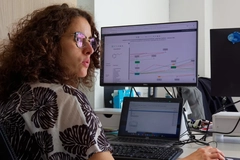
Abolis Biotechnologies has launched Microbial Intelligence Explorer (MINE), a platform that helps cosmetics players understand, interpret, and act on complex biological data for easier decision-making in the cosmetics pipeline.
The launch comes as the beauty industry increasingly leans on tech-driven innovation. Consumers are demanding more sustainable and high-performance cosmetic ingredients, and many brands are responding by investing in biotech for greener alternatives.
However, science-based innovation often hinges on complex biological information, and R&D teams may lack the tools to interpret multi-omics data effectively — the gap that MINE aims to fill.
The French biotech company says MINE is intended for cosmetics innovators, manufacturers, and R&D teams who work with microbial systems but struggle to know which findings are important for a formulation.
Instead of relying on trial and error, Abolis positions the platform as a tool to design smarter experiments and optimize R&D and innovation processes faster.
“The challenge in microbial biotechnologies lies in the difficulty of integrating the various pieces of information and, therefore, knowing which signals matter and which hypotheses deserve further testing for product development,” says Sylvia Julien, general manager, MINE business unit at Abolis.
.webp) Abolis’ MINE platform aims to simplify complex microbial data for beauty R&D teams.“MINE gives teams a clearer way to navigate that complexity, helping them focus experimental work on the questions most likely to move a program forward.”
Abolis’ MINE platform aims to simplify complex microbial data for beauty R&D teams.“MINE gives teams a clearer way to navigate that complexity, helping them focus experimental work on the questions most likely to move a program forward.”
Better, faster decisions?
The platform combines genomic exploration, multi-omics analysis, and experimental interpretation in one tool. It shows how individual microbial strains can produce molecules that are useful in formulations, how these microbes interact in complex systems, and which parameters can improve the process.
MINE then links the findings to partners’ technical and industrial constraints. By doing so, the platform helps users spot where they need validation, which experiments are most likely to yield productive outcomes and should be prioritized, and where resources should be focused for the most credible development routes.
The tool grew out of Microbiome Studio, an analytical platform created through an industrial program backed by the French government.
Abolis first built the platform for its own microbial biotechnology work. It then refined it through industrial collaborations before turning it into MINE for external R&D and innovation teams.
Now, it is touted to make microbial data easier to use, also for people who are not omics or bioinformatics specialists.
“MINE software release marks the point at which more than a decade of microbial-biotechnology, data, and industrial experience of Abolis becomes a platform to boost partners’ research and our own research,” says Cyrille Pauthenier, co-founder and CEO at Abolis.
“It strengthens Abolis’ ability to support decisions before, during, and beyond experimentation, connecting biological evidence with the realities of validation, process development, and scale-up. For our partners, that means a clearer route from microbial potential to an industrially relevant program.”
.webp) The platform connects biological insights with experimentation, validation, and scale-up.The tool’s launch fits into Abolis’ wider ideation-to-scale model. MINE connects microbial intelligence with the company’s own capabilities in strain engineering, enzyme modeling, fermentation, bioprocess development, and scale-up support.
The platform connects biological insights with experimentation, validation, and scale-up.The tool’s launch fits into Abolis’ wider ideation-to-scale model. MINE connects microbial intelligence with the company’s own capabilities in strain engineering, enzyme modeling, fermentation, bioprocess development, and scale-up support.
The company’s partners can therefore use the platform to assess the biological potential and industrial feasibility of different microbes in the same space.
Accelerating lab to aisle
The software release arrives as the cosmetics industry doubles down on biotech innovation, and computationally-assisted ingredient discovery has emerged as a key way R&D teams manage the shift.
Recently, Debut and Natura partnered to commercialize a longevity ingredient complex. The duo used AI to screen 96 billion molecular possibilities in days instead of what the companies said would take centuries without the tech.
With consumers demanding fresh rotations of new beauty products faster than before, the cosmetics industry has been investing in speeding up and reinventing linear R&D processes.
Previously, Personal Care Insights sat down with Atelier, Accenture, and Nearshore, who told us that slow development cycles in the beauty industry are leaving billions of dollars on the table, highlighting the value of interventions that speed up the path from discovery to commercialization.