




dsm-firmenich 3D facial microbiome mapping poised to transform common skin conditions
The company’s latest insights could illuminate the ecological mechanisms underlying acne, seborrheic dermatitis, and other skin conditions.

Key takeaways
- New technology from dsm-firmenich enables continuous visualization of 26 bacterial and fungal species across 24 facial sites.
- The approach identifies region-specific bacterial–fungal interactions, allowing cosmetic developers to design microbiome-modulating actives with precise and localized efficacy.
- Machine learning models demonstrate that just nine sampling sites, particularly the central forehead, can predict overall facial microbiome variability.
dsm-firmenich’s latest 3D facial skin microbiome analysis tackles some of the longest-standing limitations in microbiome research. While traditional approaches rely on relative abundance data from a limited number of sampling points, dsm-firmenich’s concept introduces absolute quantification of 26 bacterial and fungal species across 24 facial sites with AI models.
Using a smooth interpolation method, its team of scientists has created “the first” continuous 3D maps of the facial microbiome, offering a holistic and high-resolution view of microbial topography.
Its study, published in the Journal of Investigative Dermatology, marks a leap in skin microbiome research. It is titled “3D Facial Skin Microbiome Mapping: An Integrated Technology for Continuous Visualization of Absolute Microbial Densities.” By combining high-resolution imaging with machine learning, the work provides a dynamic, 3D perspective on microbial communities across the face — offering insights far beyond conventional sampling.
For cosmetic developers, these insights create opportunities to design next-generation actives that selectively support beneficial microbial communities, restore dysbiotic ecosystems, and deliver targeted effects in specific facial regions.
Strong translational potential
For the first time, researchers can observe microbial distributions in three dimensions, producing an intuitive, continuous map of bacterial and fungal populations across facial topography. This granular view captures variations that were previously invisible in traditional sampling methods.
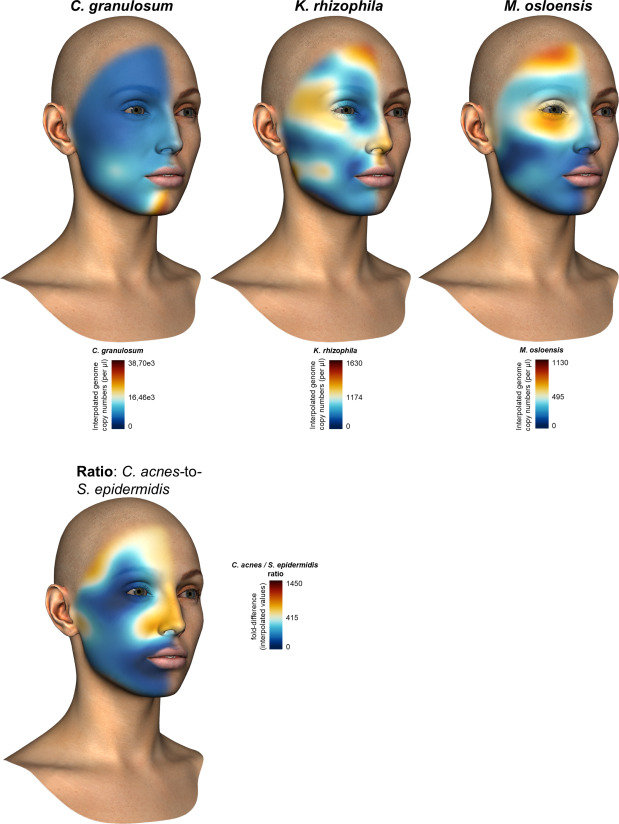 Scientists develop a novel 3D facial skin microbiome mapping technology, which unlocks new avenues for scientific discoveries.The study uncovers spatially distinct bacterial–fungal interactions, highlighting potential competitive dynamics between Malassezia restricta and Cutibacterium acnes. These insights could shine a light on the ecological mechanisms underlying acne, seborrheic dermatitis, and other skin conditions consumers may experience.
Machine learning analyses demonstrate that a reduced set of nine sampling sites can accurately represent overall microbiome variability. Among these, the central forehead emerges as a particularly predictive location, paving the way for more efficient, cost-effective sampling protocols.
Martin Pagac, senior scientist, Beauty & Care, dsm-firmenich, tells Personal Care Insights more.
How does 3D facial skin microbiome mapping technology differ from traditional relative-abundance approaches?
Pagac: Traditional facial microbiome studies primarily rely on sequencing-based relative abundance data, which describe microbial proportions but not actual microbial quantities and assume that total microbial load remains constant. In contrast, our technology combines absolute quantification of bacterial and fungal species with spatial interpolation to generate continuous 3D maps across 24 facial sites, revealing local microbial densities at high spatial resolution. Importantly, spatial interpolation requires quantitative abundance values and therefore cannot be robustly applied to compositional relative-abundance data.
This matters for formulators because facial skin comprises distinct microbial microenvironments. By visualizing microbial hotspots, gradients, and bacterial–fungal interactions, the technology provides actionable insights for ingredient development, supports more precise efficacy claims, and enables monitoring of localized treatment effects.
How do spatial interactions between bacterial and fungal species form next-generation cosmetic actives?
Pagac: Our 3D mapping approach revealed that bacterial and fungal species are not randomly distributed across the face but occupy distinct ecological niches, with species such as Malassezia restricta and Cutibacterium acnes showing spatially specific patterns and potential competitive interactions. Understanding these microbial relationships is important because skin health depends on ecosystem balance rather than the abundance of any single microorganism.
For cosmetic developers, these insights create opportunities to design next-generation actives that selectively support beneficial microbial communities, restore dysbiotic ecosystems, and deliver targeted effects in specific facial regions. The technology also enables direct monitoring of how formulations reshape local microbial networks over time.
What is an interesting finding from your study and what are its impact on sampling strategies in product testing or consumer studies?
Pagac: One of the most practical outcomes of our study was the finding that the central forehead was the single best predictor of overall facial microbiome composition within our cohort. At the same time, machine-learning models showed that a reduced set of strategically selected sites could capture facial microbiome variability. This opens the possibility of simplifying sampling strategies in product testing and consumer studies, reducing analytical costs and participant burden while maintaining data quality. Rather than relying on extensive facial sampling, future studies could focus on the most informative locations to efficiently monitor microbiome changes and assess the effects of cosmetic interventions.
How can continuous 3D microbiome mapping be applied to evaluate the efficacy of microbiome-modulating cosmetic treatments in real-world applications?
Pagac: Continuous 3D microbiome mapping provides a powerful way to visualize how cosmetic treatments alter the skin microbiome across the entire face rather than at a single sampling site. By combining absolute microbial quantification with spatial mapping, formulators can identify localized changes in microbial densities, community structure, and bacterial–fungal interactions following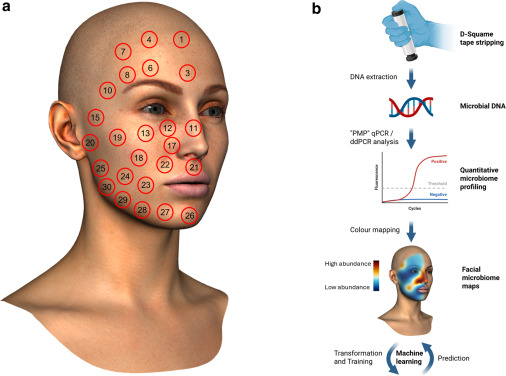 dsm-firmenich’s concept introduces absolute quantification of 26 bacterial and fungal species across 24 facial sites, combined with AI models. product use.
This enables a more comprehensive evaluation of microbiome-modulating ingredients, helping to determine where effects occur, how consistently they are distributed, and whether they support a balanced microbial ecosystem. The technology can also strengthen efficacy substantiation by translating complex microbiome data into intuitive, biologically meaningful visual outcomes.
How does this technology enable co-creation with brands and customers, and how might it help differentiate product claims or support substantiated marketing?
Pagac: This breakthrough gives us an unprecedented understanding of the skin microbiome, unlocking new possibilities for brands to develop highly differentiated, science-backed products and claims.
Our technology creates a new platform for co-creation by enabling brands and customers to visualize microbiome effects in an intuitive, highly localized way. Rather than relying solely on complex microbiome datasets, treatment-induced changes can be translated into continuous 3D maps that reveal where and how microbial communities are altered across the face. This supports the development of differentiated products and more compelling, confidential evidence-based claims around microbiome modulation. In addition, the technology can help identify region-specific treatment responses, optimize formulation strategies, and generate visually engaging efficacy data that strengthens scientific storytelling while remaining grounded in quantitative microbiome measurements.
How do you use AI, and what advantages does it provide in predicting microbial behavior or optimizing product formulation?
Pagac: AI is integrated into our microbiome visualization by predicting microbial abundance at unsampled facial locations from a limited number of measurements. This allows us to reconstruct and visualize microbiome distributions across the face without requiring dense sampling everywhere. While our study was not designed to predict microbial behavior or optimize formulations directly, these approaches could help future studies better understand microbiome responses to skin care product use and support more data-driven product development.
How do you see this approach shaping the future of personalized skin care?
Pagac: Looking ahead, this approach could support a more personalized view of skin health by helping to identify microbiome signatures associated with specific skin states rather than relying on one-size-fits-all solutions. As our understanding of healthy and dysbiotic microbiome patterns improves, such data may help guide the development of targeted, microbiome-friendly products designed to support microbial balance while preserving beneficial species. Ultimately, this could enable more precise product recommendations and intervention strategies tailored to individual skin ecosystems.