



Greenpeace urges Unilever to adopt refillables and ties Dove World Cup campaign to male fertility concerns


Key takeaways
- Greenpeace US urges Dove to phase out plastic packaging during its FIFA World Cup 2026 sponsorship.
- The NGO’s campaign links chemicals migrating from polyethylene packaging into formulations with male fertility concerns.
- Unilever cites product safety and its met recycled content target.
Greenpeace US has called on Dove and parent company Unilever to phase out plastic packaging amid the FMCG giants’ partnership with the FIFA World Cup 2026. The environmental organization cites research suggesting microplastics are turning up in men’s reproductive tissue, and contrasts it with Dove–FIFA campaign slogans such as “protect your sensitive parts.”
The NGO has displayed a 50-foot banner outside Unilever’s US headquarters with the phrase: Dove: Care for Men’s Health, Kick Plastic Out. This was performed in tandem with video projections throughout New York City, US, calling Dove a sponsor of the World Cup and a sponsor of plastic pollution. The city-wide projections also read, “Defend your balls,” linking the brand’s plastic packaging to research sparking concern around men’s fertility.
Recent studies have revealed that microplastics may be showing up in semen and penile tissue. Chemicals used in plastic packaging, including phthalates and bisphenols, are recognized endocrine disruptors and can leach from packaging into the product.
Greenpeace is arguing that Dove’s care solutions, largely packaged in polyethylene, may be capable of interfering with male hormone systems over time through chemical migration from packaging to formulation.
Tanya Brooks, senior Oceans campaigner at Greenpeace USA, discloses to Personal Care Insights that Greenpeace is not saying that the evidence is conclusive, but more that “given the gravity of the issue, it is important that the evidence that does raise such profound questions is not ignored.”
Addressing the organization’s campaign and its links to plastic pollution and male fertility concerns, a Unilever spokesperson tells us that the company’s priority is “ensuring our products are safe, and we continue to monitor research in this area closely.”
Why Dove and promising protection
Days ahead of the 2026 FIFA World Cup, Greenpeace US activists in soccer uniforms handed out red cards reading: “Dove: Care for Men’s Health, Kick Plastic Out” and “Defend Your Balls from Dove.”
“As an Official 2026 FIFA World Cup Personal Care Sponsor, Dove is selling itself as a company that cares about men. Yet its parent company, Unilever, consistently ranks as one of the world’s top plastic polluters. [This is] amid growing concerns from the scientific and medical communities about the role microplastics may play in men’s reproductive health and fertility,” says the nonprofit.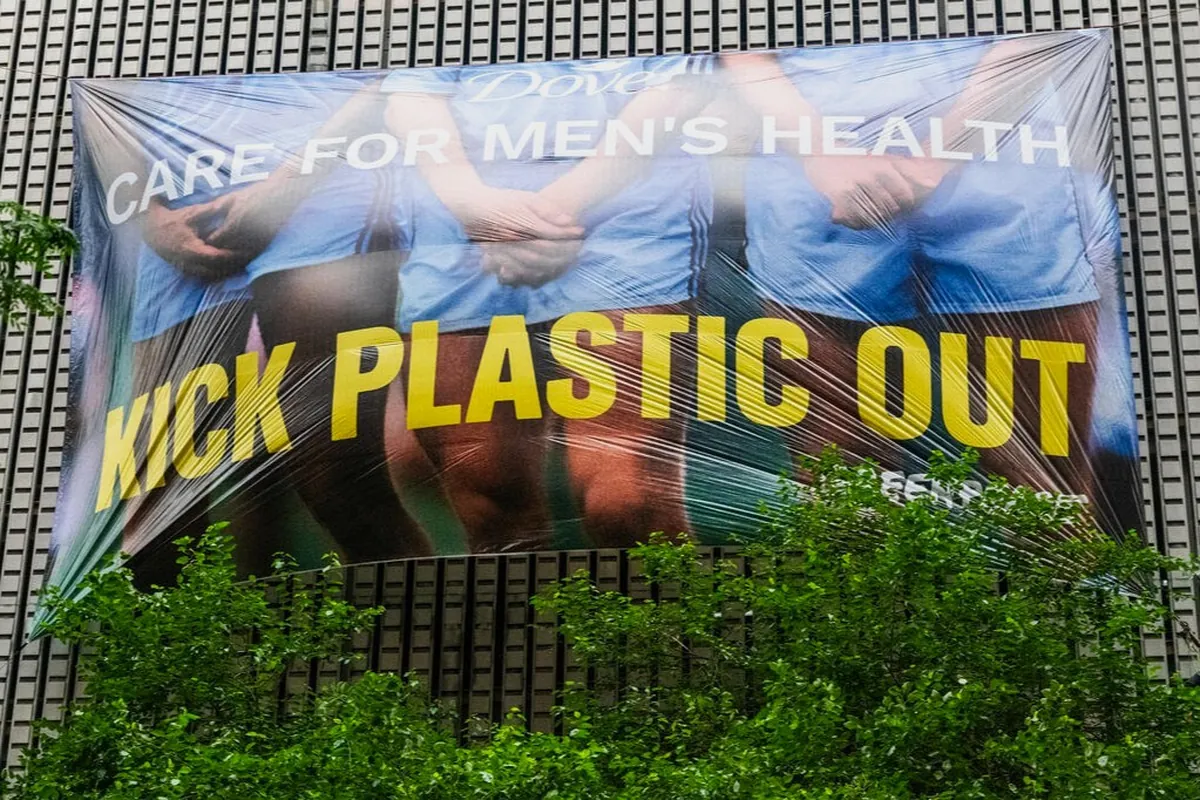 A 50-foot banner appeared outside Unilever’s US headquarters calling on Dove to cut plastic.
Greenpeace is asking Unilever to phase out plastic packaging, starting with sachets, transition to plastic-free, zero-waste reusable packaging, and support a Global Plastics Treaty that cuts plastic production.
Unilever has committed to cutting virgin plastic use 30% by 2026 and 40% by 2028 against a 2019 baseline, alongside a 25% recycled content target. The company also aims to make all rigid plastic packaging reusable, recyclable, or compostable by 2030, with flexibles — the category that includes sachets — set at 2035. It also tells us it supports a Global Plastics Treaty.
“We support an ambitious, legally binding Global Plastics Treaty that addresses plastic pollution across the full lifecycle of plastics and creates greater global alignment and consistency,” says the company spokesperson.
Greenpeace honed in on Dove because of “what its brand promises: care.” The Dove and World Cup partnership featured taglines such as: “care for your skin like you care for the game.”
Brooks calls the brand’s campaign and its practices “not just a contradiction,” but “careless.”
The multinational asserts that it has progressed toward addressing its contributions to plastic pollution.
Unilever was one of the first companies to stop using small plastic scrub beads in personal care formulations. Across its home, beauty, and personal care portfolio, the company says it is continuing to move away from slowly or less biodegradable ingredients to those that are natural or more biodegradable.
The company adds that it recognizes that “too much” plastic from product packaging ends up in the environment. “We are determined to change this. That’s why we are innovating and improving our packaging to ensure we protect the planet and our fragile aquatic ecosystems.”
However, Greenpeace’s argument from the men’s fertility side focuses on biological pollution rather than environmental pollution.
Messaging and credibility
Greenpeace says that the money Unilever used for its Dove World Cup sponsorship demonstrates that the parent company can “afford to invest in large-scale reuse-and-refill systems.”
“As an official sponsor of the World Cup, Dove has spent millions telling men it cares for their most sensitive parts. But its parent company, Unilever, is one of the world’s top plastic polluters — and now plastic pollution is showing up below the belt,” says Lindsey Jurca, senior oceans campaigner at Greenpeace US.
According to a meta-analysis published in Human Reproduction Update, sperm counts have dropped by nearly 62% since the 1974 World Cup. Some doctors have cited chemicals found in plastics as a potential cause.  Some research has linked chemicals used in plastic packaging to concerns over male fertility.
Shanna Swan, an environmental and reproductive epidemiologist known for her research on environmental contributors to declining sperm counts, says: “We are seeing decades-long declines in semen quality and testosterone levels worldwide, with chemicals in the environment linked to the declines.”
“Some of these endocrine-disrupting chemicals are associated with plastics and are showing up in placental and testicular tissue, where they can adversely impact the developing fetus. This isn’t just about men’s balls; it’s about the survival of life on the planet. It is urgent that these exposures, capable of decreasing the reproductive success of current and future generations, be removed from commerce.”
Brooks tells us that the science on the relationship between endocrine-disrupting chemicals and potential risks to reproductive health is not new, but that micropplastics’ impact is emerging. Her focus is that “the plastic pollution crisis is out of control.”
“Major consumer goods companies like Unilever can either wait and see exactly to what extent plastic-associated chemicals and microplastics are having detrimental impacts on fertility, or they can act with precaution and invest more in plastic-free solutions than it does on marketing plastic-packaged products.”
“We cannot, and will not, allow major plastic polluters to rely on inevitable uncertainties and current limits to emerging knowledge to defend inaction that could put future generations at risk.”
Packaging and eco-responsibility
Unilever calls its plastic targets ambitious and designed to drive progress in areas it can “deliver the most impact.”
In 2025, the company achieved two of its targets, reaching 25% recycled plastic content across packaging and collecting and processing more plastic packaging than it sold. Unilever also reduced its virgin plastic footprint by 29% compared to 2019 and made 57% of its plastic packaging reusable, recyclable, or compostable.
“We’re working to end plastic waste by reducing our use of virgin plastic and finding ways to keep our packaging out of the environment. Our focus remains on delivering practical, scalable solutions that can reduce plastic pollution,” the spokesperson says.
Unilever has also launched over 50 pilot reuse-and-refill projects across different markets over nearly a decade. Greenpeace urges the company to focus more of its attention on reuse models.
“The company has the data, know-how, and market influence to do more to drive these projects to scale through direct investment and support for policy change,” says Brooks.
The Unilever spokesperson confirms to us that it is expanding at-home reuse–refill options through some of its biggest brands. It details that in Indonesia, the company has a growing network of over 2,500 refill outlets.
“Every pilot delivers insights. We’ve learned changing consumer habits takes time, what works in one place might not work in another, and that scaling new packaging formats and models requires action across the value chain — from brands and retailers to waste management and policymakers,” explains the spokesperson.
“That’s why we’re also working with industry partners to test shared reuse systems on a larger scale.” 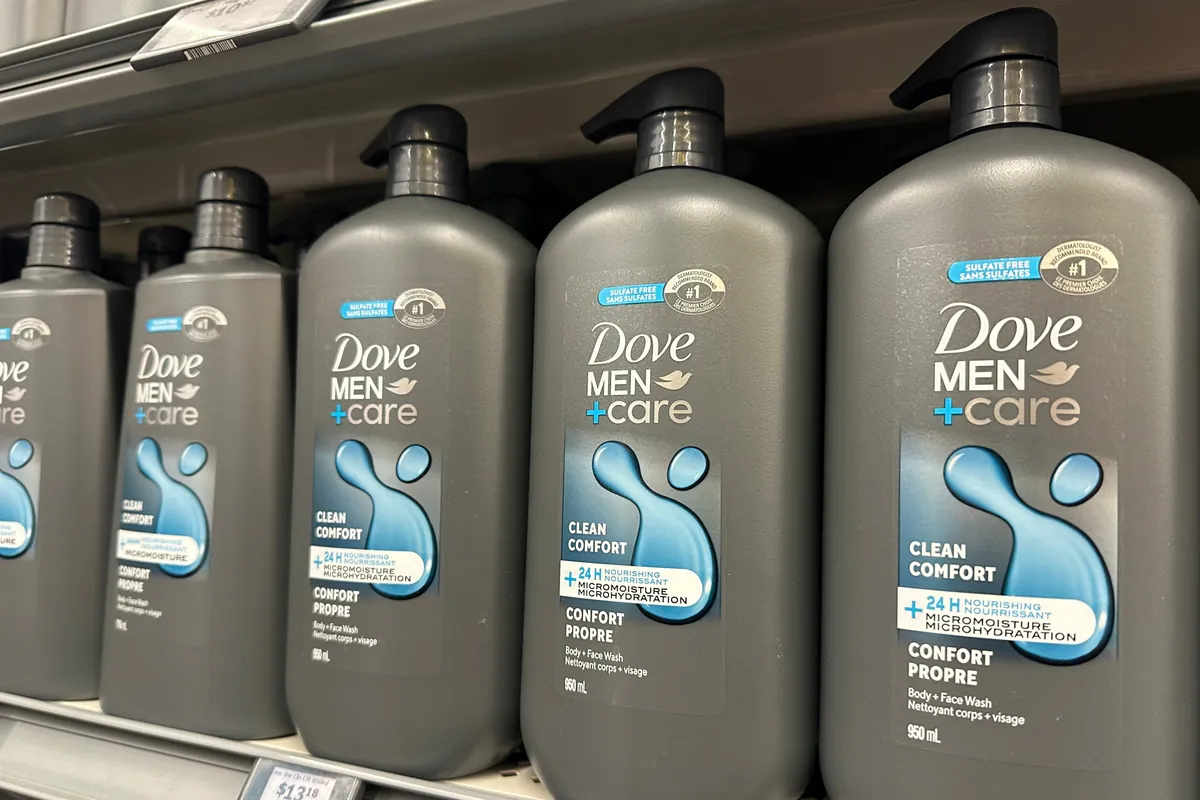 Dove is an Official Personal Care Sponsor of the FIFA World Cup 2026.
However, Brooks critiques the FMGC as being non-specific for its reuse portion. “Unilever must create a roadmap to phase out plastic packaging, starting with sachets, and transition to reuse across markets.”
The Greenpeace network has been calling on Dove and its parent company, Unilever, to ditch plastic packaging for years.
In 2024, Personal Care Insights reported on Greenpeace protestors surrounding Unilever’s headquarters in London, UK, to demonstrate against plastic pollution on the eve of the company’s 2023 financial results. The organization also called on Unilever to stop the sale of sachets used for products such as Dove shampoo.
At the time, Unilever told us it was already working to replace the hard-to-recycle packaging with more sustainable alternatives. A spokesperson said: “This is a complex technical challenge with no quick fixes, and we are fully committed to working with industry partners and other stakeholders to develop viable, scalable alternatives that reduce plastic waste.”