




Kao unpacks sweat-spreading technology to boost comfort

Key takeaways
- Kao’s technology accelerates sweat evaporation, reducing stickiness and improving skin comfort in hot conditions.
- Instead of suppressing sweat, Kao’s approach optimizes the body’s natural cooling process to maintain comfort without disrupting its function.
- The breakthrough opens opportunities for skin care formulations that balance sweat’s benefits while addressing common discomforts like stickiness and odor.
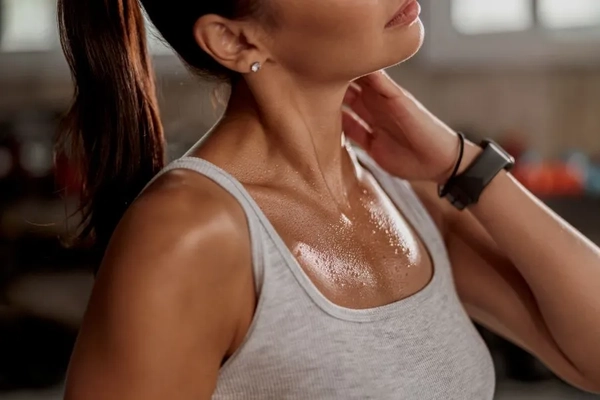
Kao Corporation’s Skin Care Products Research Laboratory has developed a technology that rapidly spreads sweat on the skin, helping it dry more quickly. The sweat transpiration technology harnesses the natural function of sweat, which is to cool the body by removing heat as it evaporates from the skin surface. The technological advancement is expected to reduce stickiness and keep the skin comfortable, even in hot environments.
Personal Care Insights speaks with Fukui Takashi, director of Skin Beauty Products Research, Business Development Research Center at Kao Corporation, a Japanese manufacturer of personal care, cosmetics, and chemicals. He says: “Many people around the world experience discomfort from sweating, such as stickiness and odor. At the same time, sweat plays an essential physiological role — as it evaporates, it removes heat from the skin and helps regulate body temperature.”
Rather than suppressing sweat secretion, Kao has focused on fundamental research into sweat’s nature, aiming to maintain skin comfort while leveraging its original biological function, says Takashi. “This technology enables sweat to spread quickly and dry faster.”
“We believe that global warming represents an environmental change so rapid that it is difficult for humans, as biological organisms, to adapt through evolution alone, making the use of technology increasingly important.”
“Our technology focuses on enhancing the body’s original physiological function of cooling itself through sweat. We see it as a way to support adaptation to hot environments without placing excessive burden on the body. We are also considering how this technology could be helpful in conditions where ineffective sweating becomes more common,” continues Takashi.
Commenting on the formulation challenges, Takashi adds that human skin has an uneven surface, which presents several challenges. “These include optimizing the arrangement of materials on the skin, ensuring good affinity with the skin, forming a film that can be applied easily in everyday use, and designing formulations that allow the film to remain on the skin without easily coming off.”
Unpacking the research
Kao’s research has found that substances such as sodium chloride in sweat make it harder to dry, and that the feeling of discomfort stems from sweat mixing with sebum. Porous silica has been found to absorb sodium chloride and sebum.
However, perspiration becomes excessive in hot environments, leaving sweat on the skin when it does not dry completely.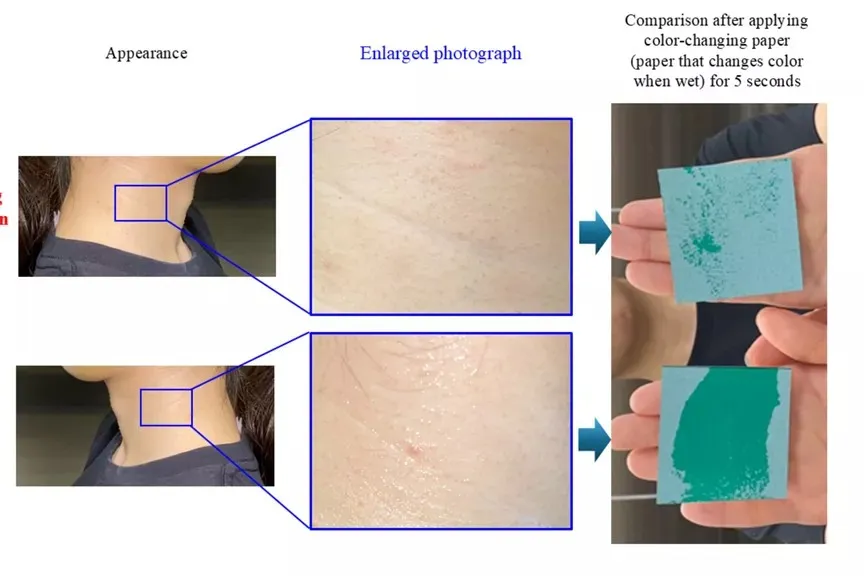 Kao has developed technology to dry sweat quickly on the skin and help prevent excessive perspiration.
Due to the hydrophobic nature of human skin, sweat tends to form droplets rather than spreading. This served as the inspiration behind Kao’s idea of creating a hydrophilic film on the skin to help rapidly spread sweat and accelerate evaporation.
Company researchers tested various materials to find one that would form a hydrophilic film. Test specimens were applied to a plastic substrate, water was dropped onto them, and the contact angle was measured after 30 seconds.
A smaller contact angle shows water spreads more easily on the surface. The test results indicated that when a specific hydrophilic plate-like powder was applied to the surface, the contact angles of water droplets decreased. Combining a hydrophilic, plate-like powder with porous silica further reduced the contact angle, indicating that water spreads rapidly.
Synthetic leather was used to mimic skin in experiments to confirm whether sweat would dry more easily if spread over a large area. A prototype formulation containing hydrophilic plate-like powder and porous silica was applied to the synthetic leather, and artificial sweat was sprayed onto it.
When the evaporation time of the artificial sweat was measured, the sample with the prototype formulation applied had approximately 33% shorter evaporation time than the untreated sample.
Commercial skin care opportunities ahead
Takashi also says that because this technology is composed of materials that can be used in cosmetic formulations, Kao believes it has the potential to be applied across a wide range of skin care products.
“Going forward, we would like to further explore its applicability to various commercial skin care formats.”
“Sweat plays an important role in overall body function, and there have also been reports linking sweat to skin immunity, moisturization, and interactions with microorganisms. From this perspective, we 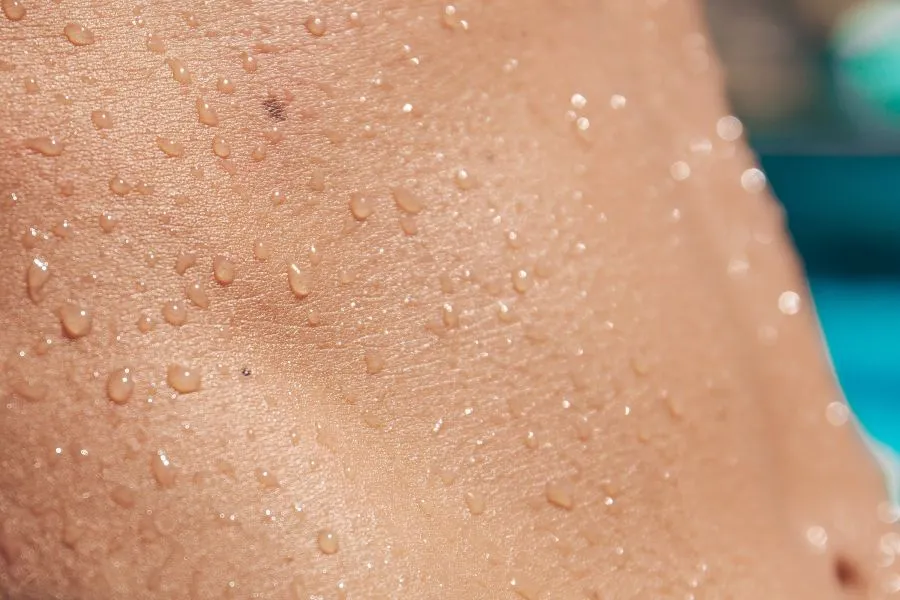 Rather than stopping perspiration, Kao has conducted research into sweat, seeking ways to keep the skin comfortable. believe there is significant potential. We aim to further develop products that allow people to benefit from the positive aspects of sweat while addressing negative factors such as stickiness,” Takashi concludes.
On the whole, antiperspirants are entering a new era, where AI-powered R&D, ingredient evolution, and microbiome-friendly claims are inspiring innovation and formulation. The rise in demand for multifunctional products, aluminum-free alternatives, and whole-body applications signals a shift in how consumers and brands approach sweat protection, according to recent research.
Going forward, Kao is on track to deepen its research into sweat and to continue ongoing investigations to reduce the discomfort caused by perspiration.
Toward the end of last year, the company unveiled ScentVista 400, a technology that analyzes olfactory receptor responses to smell. Kao said its Sensory Science Research Laboratory was the “first in the world to successfully express on the surface of cultured cells almost all of the approximately 400 types of human olfactory receptors.”