


Skinome study finds water-free retinal system improves acne-prone skin


Key takeaways
- A clinical study from Skinome found that 0.1% retinal and 10% azelaic acid improved redness, texture, and pores in acne-prone skin.
- Skinome’s water-free model limits retinal’s exposure to water until application, but the clinical trial assessed efficacy and tolerability, not chemical stability or the percentage of retinal remaining.
- The concentrate uses standardized dosing and refrigeration, supporting a modular, preservative-free approach.
A peer-reviewed clinical study has found that a water-free concentrate containing 0.1% retinal and 10% azelaic acid significantly improved several characteristics associated with blemish-prone skin, including redness, texture, surface irregularities, and pore visibility. The researchers believe the concept can be part of a broader modular approach to skin care.
The randomized, vehicle-controlled split-face trial, published in the International Journal of Cosmetic Science, is Skinome’s second peer-reviewed clinical study of its water-free retinal concentrate technology.
The formulation approach from Skinome is designed to address retinal instability. Rather than storing the active in a water-based cream, Skinome keeps it in an anhydrous concentrate that consumers mix with moisturizer immediately before application.
“We formulate retinal differently because retinal is challenging,” Ulf Åkerström, VP and chief innovation officer at Skinome, tells Personal Care Insights. “It is highly effective, but it is also highly unstable. Instead of asking how much retinal we can put into a product, we have focused on how much is actually left when it reaches the skin.”
Åkerström believes these two clinical studies are an important validation of that approach.
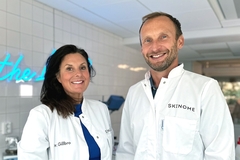
We speak with Åkerström and Skinome founder Johanna Gillbro, PhD, author of The Scandinavian Skincare Bible, about the findings, formulation rationale, and scalability of the water-free model.
Separating the actives from the vehicle
The latest study was designed to determine whether the retinal and azelaic acid system delivered benefits beyond those of the vehicle. However, it was not designed to measure the individual contribution of each active.
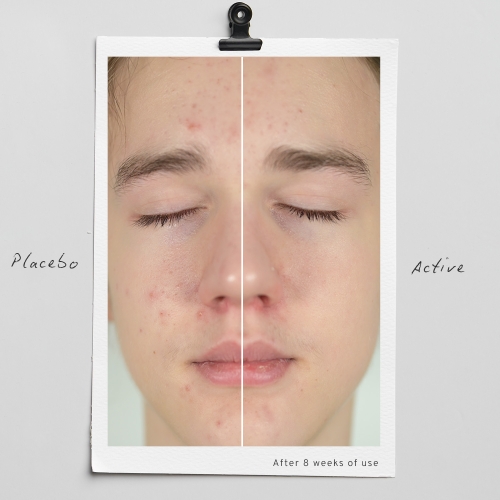 One participant, after eight weeks of use, with the vehicle side shown on the left and the active side on the right. (Image credit: Skinome)“To do that, we would have needed additional retinal-only and azelaic-acid-only treatment arms,” Åkerström explains.
“What the split-face design does is allow us to see that the difference between the active and vehicle sides is attributable to the active system rather than simply to the moisturizer, cleanser, or simplification of the skin care routine.”
The two ingredients have distinct but overlapping functions, he adds. Retinal acts on follicular keratinization and cell turnover through retinoid receptor signaling. It has anti-inflammatory and reported antibacterial activity.
Azelaic acid can offer antimicrobial and anti-inflammatory activity while influencing keratinization, sebum-related pathways, and pigmentation through mechanisms including tyrosinase inhibition.
Why remove the water?
Retinal requires one oxidative step to become retinoic acid in the skin. However, it is also vulnerable to degradation through exposure to water, oxygen, light, and heat.
Removing water from the concentrate reduces hydrolytic degradation and eliminates the need for conventional preservatives. Skinome’s concentrates contain six to eight ingredients, are stored under refrigeration, and are mixed with moisturizer immediately before application. A European patent application covers this formulation technology.
Separate research cited by the experts illustrates the wider challenge surrounding retinoids. Retinoid content declined by up to 80% at 25°C and by as much as 100% at 40°C, while light caused greater degradation than heat. Several tested products also contained less retinoid than declared on their labels.
Gillbro stresses that Skinome’s latest clinical trial assessed efficacy and tolerability, not chemical stability. It therefore did not measure retinal concentrations at production, first opening, or the end of the eight-week consumer-use period.
The company’s formulation strategy was informed by separate development work at Sweden’s KTH Royal Institute of Technology. That study examined all-trans-retinol in a related water-free oil-gel system and detected less than 4% degradation product relative to all-trans-retinol after 56 days, including under simulated real-life use.
However, Gillbro cautions that the research examined retinol rather than retinal, and its extraction method was not sufficiently quantitative to determine the precise amount of active remaining.
“It would be scientifically incorrect to convert that result into a statement that ‘96% remained,’” she says.
Gillbro points to research from the University of Ljubljana, Slovenia, that identified lower-than-declared retinoid levels in some commercial products and concluded that stability depends heavily on the formulation.
She therefore avoids presenting Skinome’s efficacy study as “a direct stability comparison with conventional emulsions.” Instead, these separate findings demonstrate why the concentration added during production may differ from the amount ultimately reaching the skin, flags Gillbro.
“For me,” says Åkerström, “the scientifically relevant question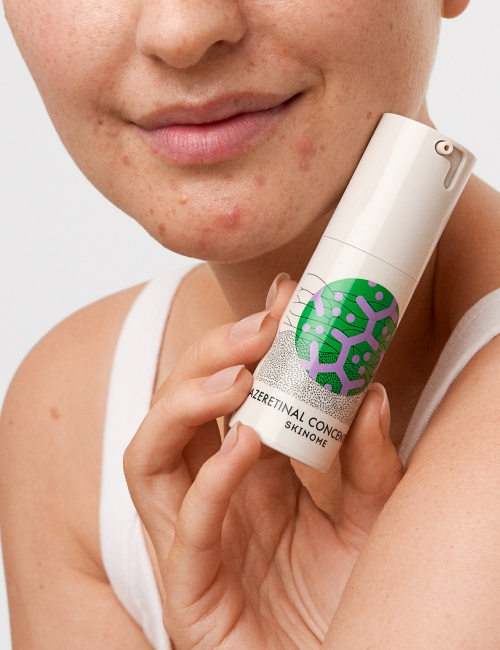 Skinome was founded in Stockholm in 2018 by Johanna Gillbro, around the principle that skin care should be formulated according to the needs of the skin. is not only, ‘How much retinoid did you put into the formulation?’ but ‘How much biologically active retinoid is still there when it reaches the skin?’”
Controlling dose and compatibility
In the retinal and azelaic acid study, an airless pump dispensed 0.2 mL of concentrate per dose. Participants mixed one pump of concentrate with two pumps of moisturizer immediately before applying it.
The metered concentrate determined the amount of retinal and azelaic acid delivered, while the moisturizer helped distribute the actives and support hydration and tolerability. This approach limits the actives’ exposure to water to the seconds between mixing and application. During storage, they remain in the anhydrous concentrate.
Skinome controlled the moisturizer used in the study, with all participants applying its Light Emulsion. The trial, therefore, does not demonstrate equivalent performance with every moisturizer available on the market.
An earlier study, published in Cosmetics in October 2025, reported improvements in pigmentation, fine lines, texture, and pore visibility after six weeks of using a 0.1% retinal concentrate.
The 2025 retinal study used several Skinome oil-in-water moisturizers selected according to skin type, following the same 1:2 mixing principle. This provided experience across a defined range of compatible emulsions but did not establish universal compatibility.
“Different formulations have different pH values, emulsifier systems, and co-actives, and those combinations should be evaluated for both tolerability and performance,” Gillbro explains.
Preservation-free design and the microbiome
Refrigeration introduces a convenience trade-off, Åkerström acknowledges, but allows Skinome to reduce the formulation compromises associated with keeping water-based cosmetics stable for two or three years at room temperature.
The approach also supports the company’s aim of limiting conventional preservatives. Although antimicrobial preservatives are necessary in many water-based formulations, Skinome is investigating how they may interact with the commensal microorganisms living on the skin.
In a randomized, double-blind split-face study published in the International Journal of Cosmetic Science in 2023, a microbiome-supporting, preservative-free regimen increased the number of unique bacterial species and Shannon bacterial diversity compared with conventional benchmark skin care. Improvements in redness and texture were also observed.
Skinome subsequently worked with researchers at Sweden’s Karolinska Institutet on a larger randomized split-face study, published in Microorganisms in 2024. The study compared preservative-free and conventionally preserved skin care in 26 women and identified differences in how the two regimens interacted with the facial microbiome.
The preservative-free regimen produced more significant associations between changes in specific bacterial taxa and skin-quality parameters such as redness, pores, and texture. Certain microbiome subgroups also experienced greater improvements in fine lines, folds, and redness with the preservative-free products.
“For us, the formulation model has two sides,” says Åkerström. “We want to protect the ingredients in the bottle, but we also want to protect the microbial ecosystem on the skin.”
A formulation model for the future?
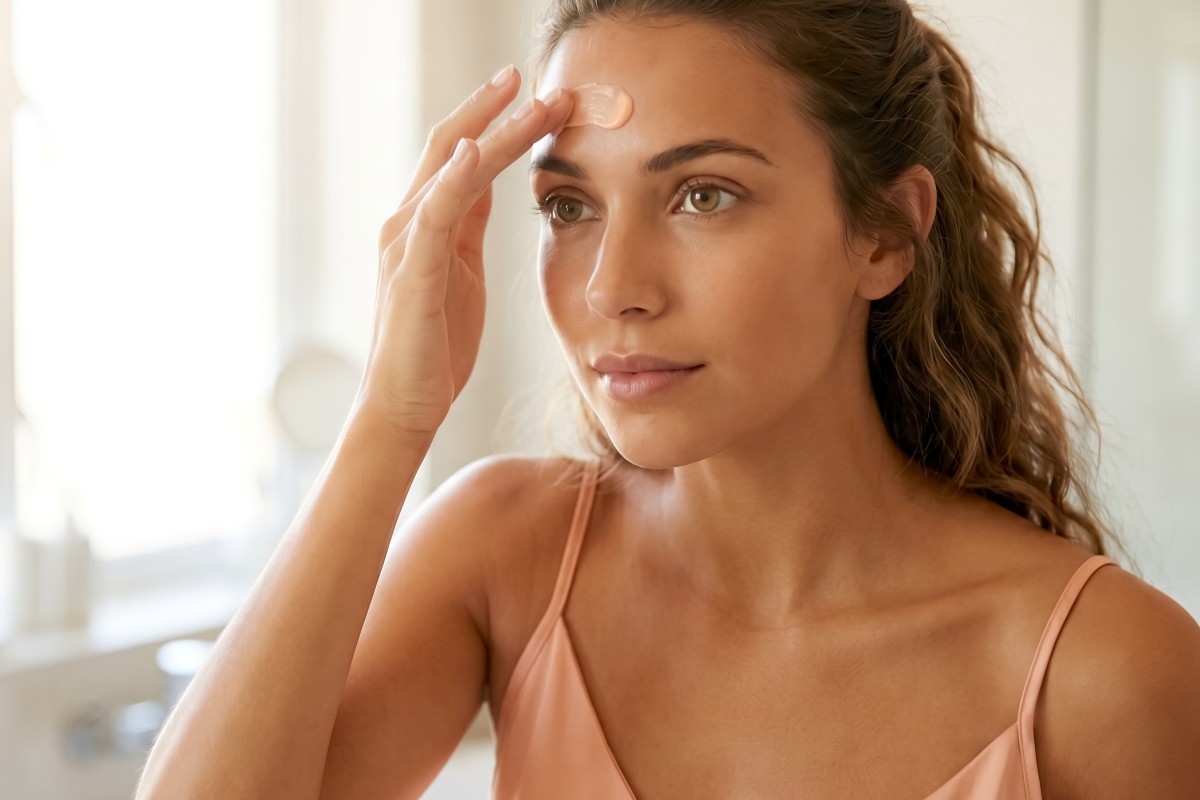 The randomized split-face trial is Skinome’s second peer-reviewed clinical study of its water-free retinal concentrate technology.Åkerström views the concentrate concept as part of a broader modular approach to skin care. Under this model, the moisturizer can be optimized for barrier support, hydration, and the microbiome, while a separate water-free concentrate is designed around the chemistry and stability requirements of a sensitive active.
The model could be scaled where there is a clear technical justification, he says, particularly for highly unstable ingredients or formulations seeking to avoid conventional preservatives.
“Instead of forcing every ingredient into one long-shelf-life emulsion, we can design each part around what is best for the ingredient and, ultimately, the skin,” Åkerström concludes.