



Why viscosity should shape filling and formulation from the brief
Thick or thin, viscosity dictates how personal care products are filled, says the company’s president.

Key takeaways
- Viscosity should shape the product brief, not just the formula, because it dictates filling, packaging, and dispensing choices.
- Temperature, shear, and measurement conditions all change how a product behaves, so teams need to test it across its whole journey.
- Skipping evaluation between an approved sample and full production risks waste, rework, and problems after launch.
A body lotion can feel flawless in a lab sample and still drip, foam, trap air, or stall on a production line. For the Midwest Sea Salt Company, viscosity moves beyond being a formulation metric and shapes everything from filling equipment to the pump in a consumer’s hand.
However, viscosity is often treated as a number on a spec sheet rather than a factor shaping the whole product. That view between an approved lab sample and full-scale production is tested when problems with filling, packaging, and dispensing become more expensive to fix.
The US-based skin care, bath, and body products manufacturer operates entirely in-house, with work spanning formulation, blending, filling, labeling, and finished-product packaging.
 Warren Watson, president of The Midwest Sea Salt Company, says R&D teams should consider viscosity while writing the product brief, not after the formula is set.Speaking to Personal Care Insights, Warren Watson, president of the Midwest Sea Salt Company, discusses how the manufacturer works directly with formulation, product development, and production. He says this offers a perspective on the complete product, including how it feels during use, how it moves through manufacturing, and whether the finished format delivers the experience the customer intended.
Why is viscosity important beyond formulation, and when should R&D teams consider it?
Watson: Viscosity affects how a formula moves through transfer equipment, enters a container, and dispenses into someone’s hand. A product can feel appealing in a laboratory sample but require a different approach when manufactured and filled at production scale. R&D teams should consider those requirements while developing the product brief, before the formula and dispensing format are finalized.
It is important to note that a flowing body wash, a pumpable lotion, and a scoopable body butter present different requirements. It is also essential to look beyond one viscosity reading. Temperature, measurement conditions, and the product’s response to shear can affect the result. The question is how the formula behaves throughout its journey, rather than simply whether it is described as thick or thin.
What filling problems occur with very thin or thick products, and how can they be prevented?
Watson: With thin products, the risks include dripping, splashing, foaming, and an inconsistent cutoff at the nozzle. With thicker products, problems can include incomplete feeding, trapped air, stringing, and slow or inconsistent discharge. The response should address the cause. Nozzle design, valve timing, filling speed, nozzle position, and the way product reaches the filler all deserve attention. Bottom-up filling can help with certain foaming products, but it is not a universal solution.
Fill checks are important because appearance alone can be misleading. Entrained air can affect the relationship between dispensed volume and product weight. The aim should be a stable process that meets the approved fill target without repeated adjustment or unnecessary product giveaway.
What additional challenges do balms, particle-containing scrubs, and transforming textures present?
Watson: These formats introduce different challenges and should not be grouped together simply because they appear thick. A wax-based balm may require controlled filling and cooling conditions to achieve its intended finished structure. Temperature needs to remain suitable for the complete formula, including ingredients that may be sensitive to heat.
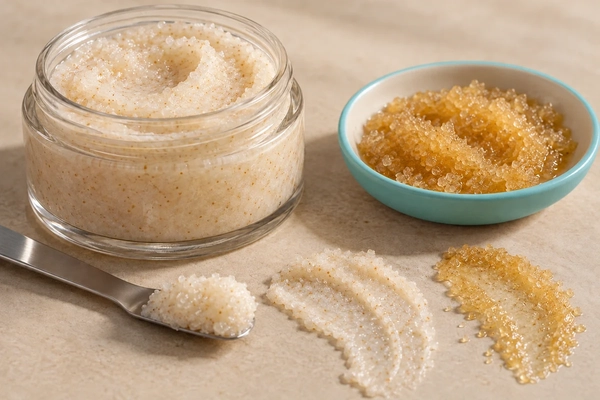
For a scrub, particle size and distribution matter alongside the base’s flow behavior. Transfer paths, valves, and nozzles need to accommodate the particles, while the process needs to maintain an appropriately consistent mixture.
For a transforming format, such as gel-to-oil, R&D should examine how processing conditions affect the intended transformation. The manufacturing process should preserve the product experience being developed, rather than achieve an acceptable fill at the expense of that experience.
What information should brands provide upfront?
Watson: Brands should describe the experience they want in terms that can be evaluated. ‘Premium,’ ‘rich,’ or ‘lightweight’ can begin the conversation, but those words need further definition. Useful information includes the product’s intended use, preferred texture, spread, finish, fragrance expectations, fill quantity, and proposed dispensing method.
Reference products can help explain a preference, provided the brand identifies the particular characteristic it likes. If viscosity data already exist, share the test method a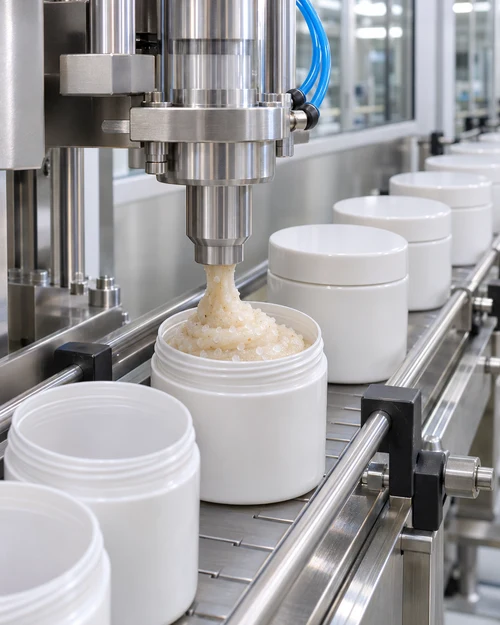 The Midwest Sea Salt Company’s product categories include bath salts and mineral soaks, body scrubs, lotions, creams, and body washes.nd measurement conditions alongside the number. Flag particles, temperature restrictions, and any known sensitivity to processing. It also helps to identify what is fixed and what can change. A manufacturer needs to know whether the formula, dispensing format, or both remain open to development.
How should viscosity guide dispensing-format decisions?
Watson: Start with how the customer is supposed to use the product, then evaluate whether the dispensing system can support that experience. A pump needs to draw in and dispense the actual formula consistently. A squeeze format needs an appropriate opening and a container the user can operate comfortably. A jar may suit a scoopable product, but that choice should follow the formula and intended use. One mismatch to avoid is selecting a dispensing format based on appearance before evaluating the finished formula. A pump that performs well with one lotion may not suit another with different flow behavior. Evaluation should include priming, repeated dispensing, dose consistency, and access to the remaining product. A successful first actuation does not establish performance throughout use.
How does viscosity determine filling equipment and process?
Watson: The filling method needs to suit the actual formula, including its flow behavior, sensitivity to processing, and any suspended particles. Piston fillers are often suitable for thicker creams, lotions, and gels. Peristaltic filling can be useful for thinner formulations where a tubing-based product path is appropriate.
Other pump systems offer options across a range of viscosities. Gravity and overflow filling have different purposes; overflow systems target a consistent fill level, which is not the same as controlling every container to an identical weight. As a practical illustration, a heavy cream may need a slower filling cycle or a different nozzle configuration to feed and discharge consistently— a wax-based product designed for hot filling needs controlled temperature through the filling path. Increasing heat or speed should never be an improvised way to force a formula through unsuitable equipment.
How should performance be evaluated across production, shipping, storage, and use?
Watson: I recommend evaluating the finished formula and dispensing system together, under conditions relevant to the product’s expected journey. That means distinguishing a viscosity measurement from a broader stability and performance assessment. Measurements need defined conditions so comparisons are meaningful. The assessment should also consider changes in texture, separation, appearance, fragrance, and dispensing after appropriate storage or temperature exposure.
Production handling matters too: the evaluation should account for the mixing, transfer, and filling conditions the formula will actually encounter. There is no single temperature, duration, or test sequence suitable for every cosmetic product. The responsible technical team should establish and document a product-specific protocol and acceptance criteria covering both the formula and the finished product’s performance in its intended container.
How do viscosity decisions affect cost and repeatability?
Watson: The effect goes beyond the price of ingredients. A formula’s filling behavior can influence throughput, operator attention, cleaning, product remaining in equipment, and the amount of adjustment needed during a run. A lower equipment cost does not necessarily produce a lower manufacturing cost if the process requires excessive intervention or creates avoidable waste. Equally, a faster filling setting is not an improvement if it causes foaming, inconsistent fills, or rework.
The best savings come from matching the process to the product early and making the approved method repeatable. That includes clear specifications, suitable equipment settings, and consistent handling. A risky place to cut effort is the evaluation between an approved sample and commercial production. Problems discovered after a launch commitment are harder to resolve.