




Pushing away from petrochemicals: Biosurfactants offer high-performance alternative


Key takeaways
- Advances in synthetic biology and precision fermentation are turning biosurfactants into customizable, high-performance formulation tools.
- Upcycled feedstocks, industrial-scale fermentation, and process optimization are closing the cost gap with petrochemical surfactants, accelerating mainstream adoption.
- Shampoos, facial cleansers, and micellar waters are driving biosurfactant uptake.

Biosurfactants are gaining traction across the personal care and cosmetics industries as sustainable alternatives to petrochemical surfactants.
Biosurfactants have faced challenges related to cost and scalability, but recent scientific advancements are changing that landscape. Now, the ingredients are evolving into modular systems that can be used as scalable, high-performance, and customizable core formulation tools across a plethora of products and formulations.
Sofie Lodens, product and project manager at AmphiStar, the Belgian biotech company, tells us about how its AmphiNova platform combines synthetic biology and advanced bioprocess engineering to design new, tailored biosurfactant molecules with the exact performance profiles.
“[The technology provides the] foaming and emulsification that personal care formulators and brands need,” she explains.
“Just as important is what we feed our processes with: 100% upcycled food waste and side streams instead of palm oil or virgin crops. This combination of a powerful molecular‑design platform enabling the variety the market wants and truly sustainable feedstocks is what finally makes high‑quality, scalable biosurfactants a real, viable alternative for mainstream personal care.”
At the recent PCHi tradeshow held in Hangzhou, China, last week, Evonik showcased its portfolio featuring targeted activeand functional ingredients for skin care, sun care, color cosmetics, and hair care.
Key products included anti-aging creams, ceramides for skin barrier support, and eco-friendly biosurfactants. Evonik presented its latest biotechnological solutions for skin and household care around the theme: The Soul and Science of Beauty.
Biosurfactants vs. traditional surfactants
Biosurfactants perform extremely well compared to traditional surfactants from a formulation perspective, according to Lodens.
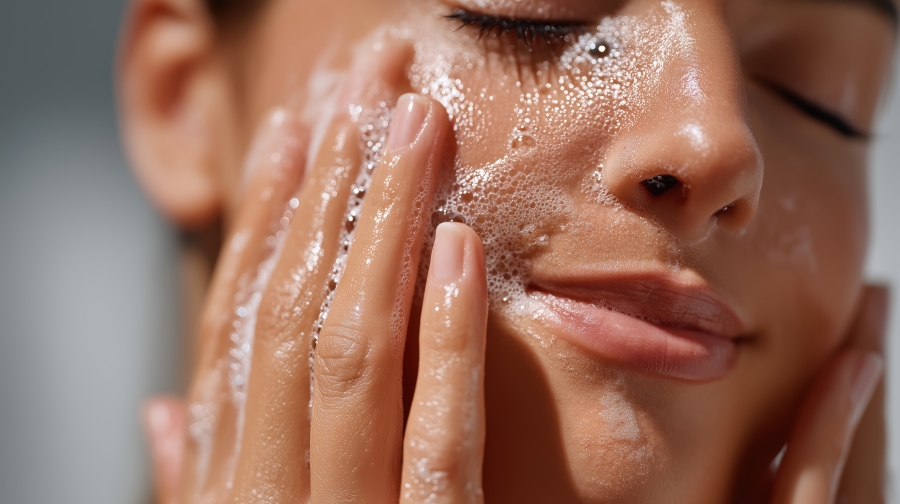 COSMOS is a widely recognized international certification standard for organic and natural cosmetics.“Our AmphiCare biosurfactants have been independently shown to deliver effective cleansing and moderate to good foaming, while offering a level of mildness that conventional fossil‑ or palm‑based surfactants simply can’t match. They show no skin irritation, no skin sensitisation, and even no eye irritation for certain grades, something which is rare in the surfactant world.”
Lodens believes these attributes make biosurfactants particularly suitable for sensitive skin, facial care, baby care, and gentle hair care formulations.
“Because the molecular structure can be tailored through our AmphiNova platform, we can fine‑tune foaming profiles, emulsification, and mildness to meet specific performance needs. So formulators don’t have to choose between sustainability and functionality — they eventually get both.”
Rising cost challenges
Last year, a study evaluating the challenges of surfactant use in the cosmetic industry highlighted the urgency for biodegradable alternatives due to environmental concerns. However, biosurfactants bring their own hurdles, including formulation, scalability, consistency, and high costs.
Lodens maintains that cost and scalability have “long been major hurdles for biosurfactants, but recent advances are shifting that rapidly.” She tells us that AmphiStar aims to address this issue on three fronts.
”First, we use 100% upcycled food‑waste and side‑stream feedstocks that — while not automatically cheaper, since they require controlled preprocessing to release the right building blocks for subsequent fermentation — are fully cost‑competitive and provide a stable, non‑volatile supply base that’s decoupled from agricultural price swings.”
“Second, by scaling through external tolling facilities with larger industrial reactors beyond 75 m³ and continuously optimizing downstream processing, we’ve significantly reduced the cost of goods through higher yields and more efficient throughput.”
Lodens adds that AmphiStar expects an additional step‑change in cost reduction as it gradually transitions to continuous processing, which it is actively investigating.
“Third, as we grow into larger commercial volumes and ultimately our own production plant, economies of scale will continue to drive costs down to levels competitive with fossil‑ and palm‑based surfactants. Combined with our AmphiNova platform, these advancements make biosurfactants not only sustainable, but truly viable for large‑volume personal care applications.”
Building application momentum
With its AmphiCare range, AmphiStar is seeing particularly strong interest in shampoos, facial cleansers, micellar waters, and makeup removers. Lodens tells us these categories are already experiencing rapid market growth for biosurfactants, and this is where their benefits are most valued.
“Industry reporting shows significant momentum in skin care cleansers, especially in products emphasizing gentleness, biodegradability, and upcycled ingredients. This aligns well with AmphiCare’s AmphiStar combines synthetic biology and advanced bioprocess engineering to design tailored biosurfactant molecules. design for shampoos and skin care cleansing formats, where surfactants are core functional ingredients, and biosurfactants can directly enhance sensory performance and mildness,” says Lodens.
Biosurfactants’ skin‑friendly, biodegradable, and non‑toxic nature makes them especially attractive for makeup removers and gentle cleansing products.
“Importantly, biosurfactants are naturally well‑suited for microbiome‑friendly and sensitive‑skin formulations because of their inherent mildness and clean toxicological profile,” flags Lodens.
AmphiStar’s AmphiCare biosurfactant line has been independently shown to cause no skin irritation, no skin sensitisation, and even no eye irritation for certain grades, which is something traditional surfactants often struggle with. “This makes them especially gentle on the skin barrier,” continues Lodens.
“Their molecular structure also leads to softer cleansing actions that don’t strip away lipids or disrupt the microbiome, which is increasingly important for brands formulating for sensitive skin or scalp.”
The future of biosurfactants
Regulatory frameworks and certification schemes continue to shape ingredient choices.
Lodens says biosurfactants fit into evolving regulatory and clean beauty requirements.
“Biosurfactants fit very well with today’s clean‑beauty and natural‑origin expectations, but certification frameworks like COSMOS — COSMetic Organic and Natural Standard — were originally built around traditional plant‑extracted ingredients rather than biotech materials made from upcycled feedstocks.”
COSMOS requires full traceability back to the original plant source, and ingredients that don’t clearly fit into its defined raw‑material categories — including some upcycled side streams — can’t be certified under the current rules.
At the same time, AmphiStar’s fermentation process and sustainability profile align with COSMOS principles around green‑chemistry processing and responsible resource use.
“That’s why we’re now selecting only traceable side streams and are already well advanced in the COSMOS approval process for AmphiCare. We’re actively working on it, and we’re getting very close, while also collaborating with the industry to ensure innovative biotech ingredients like ours are properly recognized in future natural‑origin standards,” says Lodens.
Looking ahead, Lodens sees the next phase of biosurfactant growth being shaped by three major innovation areas, all of which the company is already advancing at AmphiStar.
“First, precision fermentation and synthetic biology will continue to accelerate. That’s exactly what our AmphiNova platform is built for: we’ve already developed more than 80 designer molecules, with over 10 at high Technology Readiness Levels, allowing us to fine‑tune performance attributes specifically for personal care applications.”
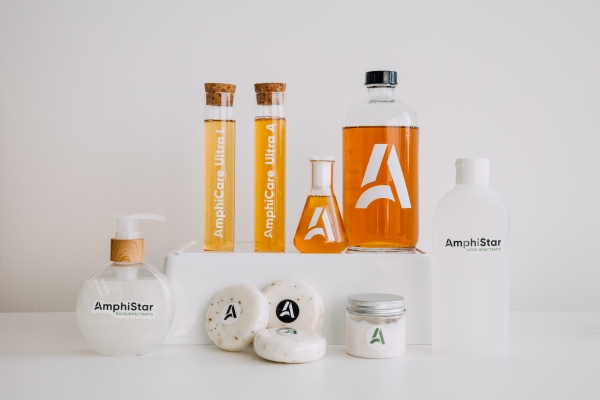 AmphiStar’s AmphiCare design for shampoos and skin care cleansing formats showcases that surfactants are core functional ingredients.“Second, ongoing strain engineering and process optimization will push yields higher and costs lower, especially as we scale beyond 75 m³ and move toward our own large‑scale production plant, where true economies of scale will kick in.”
And third, hybrid systems -combining biosurfactants with other sustainable ingredients- will open new formulation possibilities, enabling brands to dial in foam, mildness, and sensorial properties in ways that simply aren’t possible with traditional surfactants, she notes.
“Together, these developments point to a future where biosurfactants aren’t just greener alternatives, but fully customizable, high‑performance ingredients that can define the next generation of personal care formulations.”
Businesses expand biosurfactants
Toward the end of last year, AmphiStar entered into an exclusive distribution partnership with Caldic to expand access to its upcycled biosurfactants across Europe. The collaboration aims to support formulators’ demand for sustainable, upcycled ingredients ahead of the EU’s proposed European Green Deal and Biotech Act.
Similarly, Evonik divested its betaines business in Bekasi, Indonesia, as the company continues to adjust its portfolio toward sustainable specialty chemicals. Betaines are widely used across shampoos, conditioners, and skin care products, but Evonik sees greater long-term value in investing in high-growth beauty segments.
Evonik says the decision aligns with its strategy to focus on biosurfactants and high-growth personal care actives. The company cites increased demand for greener and high-performance ingredients.