


K-beauty effect: Diving into Sephora’s sales, buys & business strategy
How Asian beauty, private label, and price-conscious shoppers reshape the retailer’s playbook


Key takeaways
- K-beauty brands are becoming more prevalent at Sephora and are delivering clinical performance at accessible price points.
- Sephora’s private label and Korean brands are reshaping prestige beauty toward value-conscious shoppers.
- Rising Asian beauty retailers like Sukoshi are intensifying price competition in the US.
Sephora has expanded its Korean beauty offerings amid its shoppers’ preference for cost-effectiveness and growing competition from other major retailers.
A report from Navigo Marketing shows that online consumers are favoring price-conscious choices, value for money, and quality over prestige. The review revealed that Sephora’s own product line is growing. The in-house brand positions itself as a bridge between drugstore and prestige.
K-beauty’s skin care and makeup ethos also offer a solution at the intersection of price and performance. Sephora has recently expanded its Korean offerings with additions from Unove and Aestura. Both brands operate at a lower price point — Unove is especially known for its affordability.
“Sephora.com continues to dominate the prestige beauty retail landscape with a diverse portfolio spanning skin care, makeup, hair care, and fragrance categories,” says the marketing company.
Sephora has dominated the beauty retail space in the US for many years. However, there seems to be trouble brewing up North for the retail giant, as Sukoshi, the Canadian cosmetics chain known for importing beauty products from Asia, may lead to price undercutting.
What works at Sephora
Navigo Marketing’s report indicates that clinical skin and body care took center stage in online sales last year. The top five skin care brands captured 52% of total online category sales in 2025, led by clinical, performance-driven brands.
According to the connected commerce agency, Sephora Collection is the top brand by share of sales, holding 4.8% of the brand market share. Sol De Janeiro with 2.3% follows, and The Ordinary (2%) and Kerastase (1.8%) take the third and fourth spots.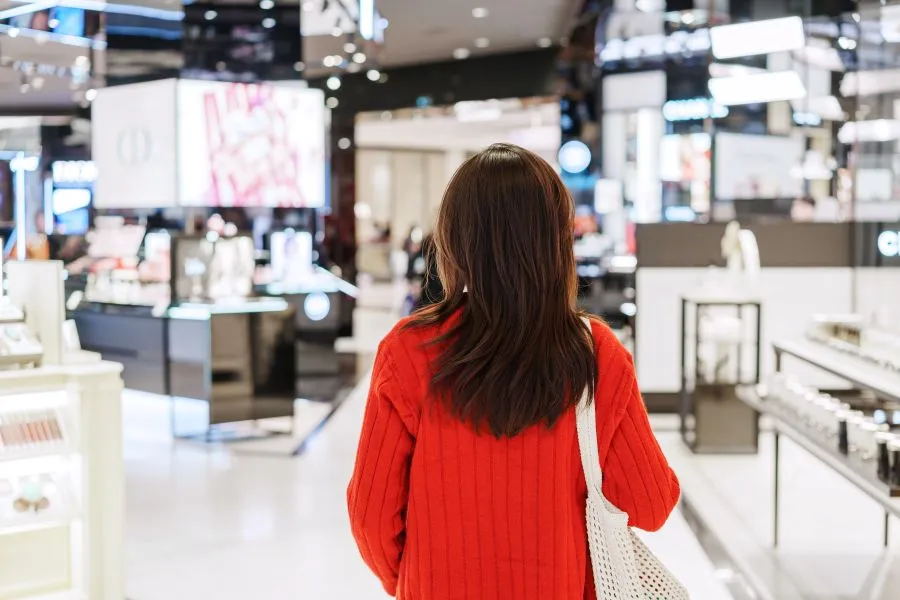 Affordable prestige reshapes Sephora’s beauty strategy.
Sephora Collection is the beauty retailer’s own brand, backed by luxury giant LVMH (Louis Vuitton Moët Hennessy). It ranked the biggest makeup brand by share of sales. Meanwhile, it also achieved second in skin care and body care.
“Sephora Collection dominates makeup at Sephora.com with 11.2% market share while hybrid skin care-makeup formulations reshape consumer preferences,” says Navigo.
Sephora is also increasingly breaking into the K-beauty space by stocking its shelves with Korean cosmetics brands. One of the mentioned K-beauty brands in the report was Laneige. It ranked fourth with 7.6% of the brand market share in the skin care category. The brand also has the eighth-most popular product in the category, its Lip Sleeping Mask.
Other Korean Beauty Brands Sold at Sephora include Cosrx, Dr. Jart+, Innisfree, Belif, Beauty of Joseon, Aestura, and Unove.
K-hair enters
Sephora added Unove to its portfolio last week, exemplifying the retailer’s move to expand its Korean brands. Unove is one of the top hair care brands in South Korea and has been the number one hair care brand at Olive Young for four years running.
Sephora and Olive Young recently announced a partnership to bring K-beauty to Sephora consumers globally. The collaboration is set to debut in the autumn of 2026 as an omnichannel partnership in the US, Canada, Hong Kong SAR, and Southeast Asia.
Unove’s entrance marks the first Korean hair care brand at the retailer. The brand is known for its affordable pricing and solutions that deliver a “glass hair” effect.  Sephora leans into K-beauty as value-driven demand rises.
The hair care brand’s introduction shows that K-beauty is not confined to skin care, but is now taking space in the hair care market. Industry sources are projecting US$8 million in first-year sales.
Currently, Navigo Marketing’s report indicates that Kérastase is the fourth-largest brand by share of sales overall, and the first in the hair care category. The French brand led with a 13.5% brand market share in hair care, followed by Amika (11.3%) and Dae (11%).
The agency identifies scalp innovation as a focus for hair brands.
K-beauty answers US demand
Korean skin care brand Aestura is also accelerating its growth with Sephora. The two have announced the next phase of their partnership with the exclusive launch of A-CICA365, a three-product collection designed to soothe skin and visibly reduce redness. The new franchise will be added alongside the brand’s Atobarrier365 collection, expanding distribution throughout 2026. It will be available in all Sephora stores across the US.
Aestura landed in Sephora in February 2025 and quickly became one of the retailer’s fastest-growing skin care brands. The Korean brand says it is a leader in Sephora’s dermatologist skin care category.
The brand offers clinical-grade solutions specifically developed for sensitive skin. Aestura is touted as Korea’s number one dermatologist-recommended dermocosmetic brand for sensitive skin, based on research conducted with South Korean dermatologists in 2023.
The new A-CICA365 Collection claims to answer growing US demand for redness-reducing, calming skin care, “an approach that has already resonated strongly with consumers in Korea.”
“This launch further strengthens Aestura’s portfolio of clinically backed Korean skin care, bringing our deep dermatological expertise and research to Sephora’s beauty-savvy clients at a time when demand for dermatologist-approved skin care and K-beauty continues to rise,” says Brian Lee, General Manager at Aestura.
Asian beauty reshapes industry
Despite Sephora’s dominance in the US beauty retail market, a Canadian player may be jumping on its turf.
Canadian-based Asian beauty retailer, Sukoshi, is sharply expanding across the US. It has opened six stores since 2025, and plans to operate approximately 40 by the end of this year.  Sephora adapts as price-conscious shoppers take the lead.
The company is planning to expand into states including Illinois, California, Texas, and New Jersey. Sukoshi’s recent store opening in Washington reportedly attracted hundreds of shoppers.
Sukoshi is Japanese, meaning “a little,” reflecting its curation of trending items from across Asia. The store carries over 200 Asian beauty brands, particularly K-beauty, J-beauty, and C-beauty products. A hot spot for the retailer is its price points — for example, it sells face masks for US$1. Its product mix includes skin care, makeup, sunscreens, sheet masks, hair care, and body care.
Retail expert Carol Spieckerman told the Daily Mail: “Despite Ulta and Sephora’s dominance — and despite every big box, drug store, and grocer pushing deeper into beauty — there’s absolutely room for compelling alternatives.”
“They’re not just competing for customers; they’re competing for the hottest brands, many of whom may prefer Sukoshi’s cool factor over potentially getting lost on Ulta or Sephora‘s packed shelves.”
“Asian beauty isn’t a momentary trend — it’s fundamentally reshaping how North Americans think about skin care and cosmetics.”