




Perimenopause knowledge gaps open doors to targeted personal care

Key takeaways
- US women have a significant knowledge gap about perimenopause symptoms, especially fatigue and irritability.
- High-income countries have better awareness of perimenopause, while low-income regions lag behind.
- Personal care brands can create targeted solutions for overlooked perimenopause symptoms like fatigue and mood swings.

Mayo Clinic and Flo have uncovered that US women are far less informed about perimenopause than expected in an international survey. Broader symptoms such as fatigue, irritability, and digestive changes were significantly less likely to be identified as part of the perimenopause transition. This knowledge gap presents an opportunity for personal care brands to create targeted products that address these under-recognized needs.
The US has ranked sixth in overall knowledge of perimenopause symptoms, behind the United Kingdom, Ireland, Canada, Australia, and the Netherlands.
Most women above 40 experience perimenopause. Perimenopause is the transition period leading up to a woman’s last menstrual cycle and includes the one year afterward, when menopause is established. It refers to the phase when women start to experience symptoms due to changing hormone levels.
The study, A Digital Survey of Knowledge and Symptoms using the Flo Application, is “the first digital study of its kind.” Flo is a period-tracking app that provides menstrual cycle, ovulation, and pregnancy tracking. Over 17,000 women — ages 18 and over — participated in the study across 158 countries on their general knowledge and symptoms, and attitudes toward perimenopause. The research was published in Menopause, the official journal of The Menopause Society, Global Perspectives on Perimenopause.
The study finds that among women over 35 who reported they were in perimenopause, the symptoms were significantly higher than among women who reported they were not yet in perimenopause. Fatigue, physical and mental exhaustion, and irritability were the most common self-reported symptoms experienced during perimenopause.
“We need to normalize conversations around perimenopause and menopause, so women feel empowered to have honest conversations with their doctors and other support systems,” says Dr. Anna Klepchukova, chief medical officer at Flo, in a statement shared with Personal Care Insights.
Symptom and knowledge overlook
Among women over 35, the most commonly reported symptoms experienced regardless of reproductive stage were fatigue (83%), physical and mental exhaustion (83%), irritability (80%), depressive mood (77%), sleep problems (76%), digestive issues (76%), and anxiety (75%).
Women who reported being in perimenopause, the top five symptoms were physical and mental exhaustion (95%), fatigue (93%), irritability (91%), sleep problems (89%), and depressive mood (88%).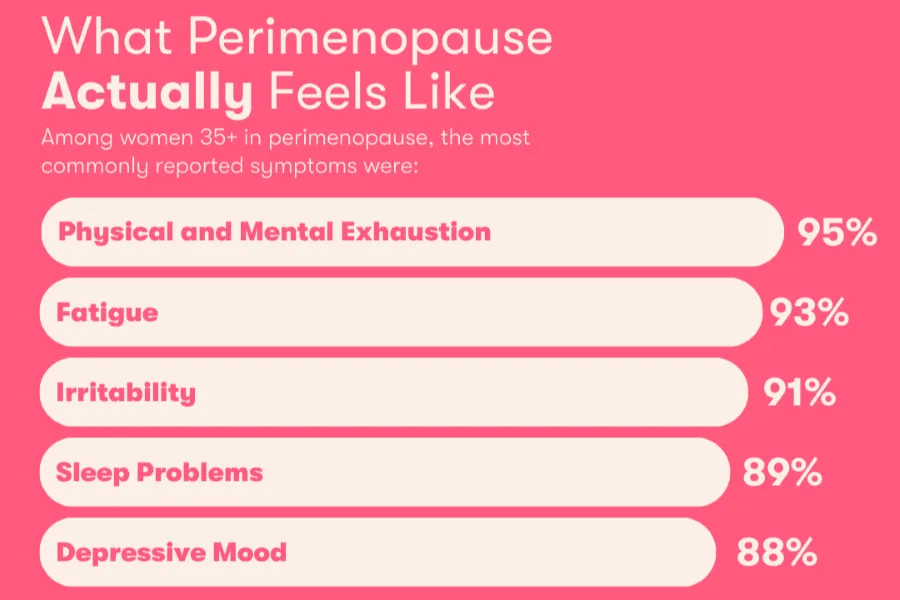 Research from Flo and Mayo Clinic shows a need for more perimenopause care solutions.
However, these mental symptoms were significantly less likely to be associated with the perimenopause transition. Participants most often recognized common perimenopause symptoms such as hot flashes (71%), sleep problems (68%), and weight gain (65%).
“There is a mismatch in knowledge and expectations of perimenopause and actual symptoms experienced during perimenopause. Many women in perimenopause may not yet be experiencing hot flashes, and are more likely to be experiencing the cognitive and physical symptoms of fatigue, exhaustion, mood, sleep, or even digestive changes,” says Dr. Mary Hedges, principal investigator at Mayo Clinic, in a statement shared with Personal Care Insights.
“The findings from this study illustrate the need to advance perimenopause research and education, so that we can… address symptoms and improve the quality of care we provide to women.”
Country breakdown
The study found country-dependent variability in reported symptom prevalence.
Digestive issues ranked among the top three reported symptoms in Nigeria, South Africa, India, France, Ireland, and several Latin American countries, while mood symptoms, such as depressive mood and anxiety, ranked among the top three reported symptoms in Germany, Spain, Venezuela, the Netherlands, and India. Sleep disturbance ranked among the top three in Nigeria.
UK participants scored highest in symptom knowledge, while the lowest scores were reported in Nigeria, France, and parts of Latin America.
The perimenopause knowledge scores were highest in higher-income countries such as the UK, Ireland, and Australia. Overall, women in high-income countries demonstrated broader perimenopause symptom recognition than in low- and middle-income countries.
However, Flo reports that overall knowledge scores were low across all regions.  Misunderstood symptoms of perimenopause show a need for awareness and innovation.
“Even as US conversations about menopause grow louder, from celebrity advocacy to new workplace policies, the study suggests many women may lack the foundational knowledge needed to identify early symptoms and seek timely care,” says the period-tracking app company.
Industry opportunities
Flo and Mayo Clinic’s findings can impact the personal care industry by driving innovation across product development and brand messaging.
Since women experience a broad range of symptoms during perimenopause, including fatigue, irritability, and digestive changes, brands and ingredient developers have the opportunity to create products tailored to these often-overlooked needs.
Industry players can develop targeted solutions, such as mood-balancing or energy-boosting beauty-from-within ingredients, and actively promote awareness to educate consumers, positioning themselves as leaders in the growing market.