


Promotional banner from Mibelle Group Biochemistry featuring PhytoSpherix™ Hair plant-based glycogen, green background, and smiling blonde woman
Home
Videos
ÄIO: Yeast fermentat...

ÄIO: Yeast fermentation as sustainable alternative to cosmetic oils 

15 Dec 2025 | ÄIO

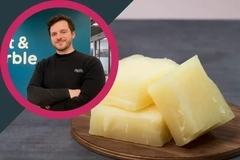
Magdalena Koziol, head of cosmetics development at ÄIO, tells us how the company’s technology uses biomass fermentation to create sustainable alternatives to traditional plant- and fossil-based oils. The company uses fermentation rather than agriculture for various cosmetic applications, such as skin and hair care.
This is Beatricez Vilander for Personal Care Insights.

Joining me today is Magdalena Coscio, head of cosmetics development at IO.

Welcome.

Thank you for having me, it's a pleasure.

Would you like to start with giving an introduction of yourself and the company that you represent?

Thank you, yes.

My name is Magda and I work for a startup company called Ayo.

We are based in Estonia and we are a spin-off company from Caltech, so Technical University in Tallinn.

And what we do is we produce oils and fats using fermentation process.

So we don't use traditional agriculture for this, but we use fermentation process to produce these specialty lipids for different purposes, for different sectors, for food, for cosmetics, for bio-based materials, so yeah, applications are vast here.

All right, thank you.

And can you elaborate more on how the fermentation process works and also what are the cosmetics applications that the lipid yeast derivatives will be used for?

Great, yeah, sure, no problem.

So our process works a little bit like brewing a beer, but instead of a yeast that produces alcohol, our, yeast produces oils and fats, it accumulates them, and we feed the yeast with low value renewable side streams from different industries, so from, for example, from food industry, agricultural or forestry industry.

And it naturally produces produces this high quality oils, so it's a clean, traceable way that doesn't require vast amounts of land or mono agricultures or intensive resources.

And as I mentioned already, the applications are very broad.

So, more specifically across the skincare and haircare, they can be used in kind of all kinds of products, so creams, lotions, serums, conditioners, detergents, cleansing products, soaps, so on.

They give texture, they give performance, so very much the same qualities that formulators are looking for from traditional oils.

But the exciting part is in the future we can design them or tailor them er with new functionalities to go beyond what the commons oils can do or what can be found in nature.

Thank you.

And what are these oils that it that it replicates?

You said traditional oils, so, in specific, which oils does it?

Yeah, so, the big one we're trying to replace is palm oil and its derivatives, which are everywhere in cosmetics, but they come with deforestation, they come with loss of biodiversity, with mono agriculture, with high carbon emissions.

So we are offering alternatives to to the palm oil, coconut oil, so these tropical fats, but also other traditional oils and emollients, so either plant-based or fossil-based emollients and oils and lipids.

So, in short, we give brands the chance to keep the performance while improving sustainability and traceability and have these locally sourced alternatives.

Thank you.

And you recently received funding for the research project.

Would you like to tell us more about that and what is IO aiming to achieve in terms of sustainable cosmetics?

Great, yes, er, so yeah, you're right, we recently received funding from Estonian government, who have been very supportive of IO and this is to help us develop our technology, our lipids, and scalar technology specifically for cosmetic purpose.

So this will allow us to optimize the production, optimize production product development.

But also accelerate the regulatory approval as and test our oils directly in formulations, which is super important.

So yeah, the goal is to make sure that, brands, personal care brands have sustainable but high performing option to transition away, from these unsustainable, lipids.

Alright, and you mentioned that you're planning to scale up er internationally.

So do you already have partnerships in place with cosmetic manufacturers er or anyone else, and if so, can you detail which ones?

Yeah, that's right.

So we've been scaling up already this year.

So, just this year we managed to scale up to 10,000 L, so that's 10 cubic meters, and very excitedly, we produced our first ton of oils, which is a huge milestone for us.

I know for, big industry players, this seems like nothing, but this is a real validation for us that our technology can work and can be, at an industry level.

Our next target is 100,000 L, so 100 cubic meters, and this takes us much closer to this commercial scale.

And yes, we work with CMOs, so contract manufacturing and some other industrial partners, and we're already testing with quite a few international industrial partners.

Unfortunately I can't name any names yet because those projects haven't gone public yet, but the feedback has been great and overwhelmingly positive.

But yes, as soon as I can release some more information, I'm sure you'll be first to know.

All right, thank you for that.

And for the upcoming EU deforestation regulation, what shift is needed for the industry to be able to align with the regulation and since it's now been pushed forward for one more year, do you think that the industry will be able to adapt within this new time frame?

Mm.

It's a good question because, yeah, palm oil is such a high functioning ingredient, such a cheap ingredient, but present in so many of products in the cosmetic industry.

And yeah, it's a tough shift for for the industry sector because it's everywhere and the supply chains are so complex here.

So it's it's a, it's an interesting question.

It's a difficult one.

I think this is not going to be easy, and I think that's why we see this shift for the second time now.

We had this deadline being pushed again.

And yeah, I think it's not going to be easy because so far I think it's only about 19% of palm oil that is certified, and even so, even this palm oil still has to go through this additional, proof of being deforestation free.

So, I think this is only realistic if companies adapt and quickly, and if they adapt to innovation.

Because biotech ingredients like ours, for example, come with this built-in traceability, sustainability, which makes compliance and their life and their supply chains much simpler.

So yeah, this can be, I think, a real opportunity for the industry to move away from these unsustainable sources, but they have to embrace innovation.

But yeah, brands like Ayo are here to help.

All right, thank you.

Do you have any other comments?

I think, yeah, generally, I would just like to, comment that, biotechnology isn't just about replacing what exists.

I know, a lot of customers have this idea that nature equals good and biotechnology can raise concerns or biotechnology derived ingredients can come with a question mark.

And what I would like, just like to say is that biotechnology can can take what's good in nature and actually improve it in a controlled environment, and before long, this already exists, even we'll be able to tailor make cosmetic ingredients for specific needs and specific performances, so , yeah, that's the future we're working towards, being more sustainable, being more innovative, but bringing better, higher performance.

All right, and what are those common questions, marks, or concerns about using biotechnology?

Yeah, it's a good question.

I think it's the question of unknown.

A lot of the time for the customers, it's a question of education as about.

The fact that biotechnology comes with the same safety regulations, the quality regulations, or even higher standards than traditional sourcing of materials.

So I think yeah, it's all about educating our customers and showing them that biotechnology can bring.

The same or better, quality of ingredients, but at a lower environmental cost.

Thank you very much.

Great.

Thank you so much.

More videos

Image