



Greece investigates invasive fish as cosmetic ingredient resource


Key takeaways
- Greek researchers are exploring invasive fish as new cosmetic ingredient sources to mitigate the fish’s environmental and economic harm.
- From testing, the three fish species yielded collagen, omega-3s, and a toxin with potential beauty applications.
- The research comes as beauty increasingly shifts toward animal-free ingredients, raising flags about strengthening the market for fish-derived products.
Scientists in Greece are exploring whether toxic and invasive fish species disrupting the Mediterranean fishing industries and ecosystems could be used for cosmetic ingredients.
The research aims to offer a sustainable and circular approach to marine ecosystem management, and could open up new opportunities for cosmetic formulations. However, it also raises questions about whether it contributes to normalizing the use of animal-derived ingredients in an industry increasingly moving toward cruelty-free and vegan alternatives.
A report by the Cyprus Academy of Sciences, Letters and Arts, based on research by scientists in 11 countries, has found that a new non-indigenous fish species enters the Mediterranean every two weeks. The researchers say climate change is a major driver, as warmer waters are making the Mediterranean more hospitable to tropical species.
The transition is raising red flags for environmentalists. Ocean conservation NGO Oceana estimates that, despite covering 0.8% of the global ocean, the Mediterranean supports up to 18% of the world’s marine species.
To curb the overpopulation of invasive marine species, project ExplIAS aims to research commercially viable applications for the fish in the cosmetic sector. The project is co-funded by the EU and Greece, and forms part of the National Technical University of Athens, led by Professor Magdalini Krokida.
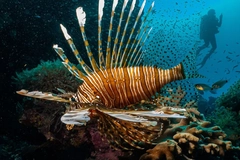
ExplIAS focuses on three problematic marine species: the silver-cheeked pufferfish, lionfish, and bluespotted cornetfish. Their research has found that each species has compounds, such as collagen, omega-3 fatty acids, and neurotoxin tetrodotoxin (TTX), that could have aesthetic injectable applications.
.webp) The researchers found that TTX from silver-cheeked pufferfish could be used to develop injectable products such as Botox.However, the personal care industry has made progress toward phasing out animal-derived products from global beauty supply chains. From consumer, regulatory, and business sides, demand has accelerated for vegan alternatives to ingredients with traditionally animal origins.
The researchers found that TTX from silver-cheeked pufferfish could be used to develop injectable products such as Botox.However, the personal care industry has made progress toward phasing out animal-derived products from global beauty supply chains. From consumer, regulatory, and business sides, demand has accelerated for vegan alternatives to ingredients with traditionally animal origins.
Triage of cosmetic applications
ExplIAS researchers focused on finding valuable cosmetic compounds in each invasive fish species. They discovered that lionfish skin contains around 13 times more collagen than salmon skin, at 34.84 mg per gram compared to 2.6 mg.
“[Lionfish] is a rich source of marine collagen, which has the ability to slow down the formation of free radicals by preventing skin aging, as well as fortifying skin repair and regeneration,” the study reads.
The researchers also found bluespotted cornetfish showed promising levels of omega-3 fatty acids in its skin, with a lipid content 65% higher than in its flesh.
“Omega-3 fatty acids have beneficial properties for skin, protecting it from the photo-aging process, skin carcinogenesis, dermatitis, and also reveal a positive effect on the healing of skin wounds,” says the research.
Meanwhile, the silver-cheeked pufferfish contains TTX, a strong neurotoxin that the researchers believe has potential use in injectable treatments. “In the field of cosmetics, one possible use of TTX could be the development of injectable products such as Botox, to treat skin relaxation.”
Moreover, the pufferfish’s internal organs contained much higher toxin levels than the flesh, at 14.10 micrograms per gram compared to 1.77.
.webp) Fishermen can get bounties for pufferfish hauls as part of a pilot program led by Greek and Cypriot authorities.Project ExplIAS is presently in the research phase, and no cosmetic products have been placed on the market. While the scientists have shown that the ingredients can be extracted and processed, they assert they have not proven that these ingredients act effectively and safely on human skin.
Fishermen can get bounties for pufferfish hauls as part of a pilot program led by Greek and Cypriot authorities.Project ExplIAS is presently in the research phase, and no cosmetic products have been placed on the market. While the scientists have shown that the ingredients can be extracted and processed, they assert they have not proven that these ingredients act effectively and safely on human skin.
“To cover the unpleasant odor of fish-origin bioactive compounds and to protect them from adverse environmental conditions, their encapsulation in natural origin polymeric matrices is necessary,” the project further outlines.
Mutually beneficial population control
ExplIAS is investigating whether invasive fish can become useful sources of raw materials. According to the researchers, they have an impact on the local fishing industries and marine ecosystems. Lionfish, for example, have no natural predators in the Mediterranean and eat large numbers of native fish and crustaceans.
The pufferfish is highly toxic and can destroy fishing nets due to its powerful teeth. It cannot be sold as food, and fishermen therefore have little reason to catch it. Pufferfish are carnivores whose toxins can be fatal to humans and attack other fish. They have also been linked to reports of reduced octopus catches.
A survey by the Hellenic Center for Marine Research found that in Crete, Greece, fishermen are losing an average of €6,500 (US$7,543) per vessel due to pufferfish preying on local species. The government has responded, with Greek and Cypriot authorities offering fishermen bounties on pufferfish hauls as part of a pilot program.
.webp) Lionfish skin was found to contain around 13 times more collagen than salmon skin.ExplIAS’ broader goal is to create a mutually beneficial situation where cosmetics companies gain new natural ingredients, and the invasive fish populations are controlled, benefiting the local fishing economy.
Lionfish skin was found to contain around 13 times more collagen than salmon skin.ExplIAS’ broader goal is to create a mutually beneficial situation where cosmetics companies gain new natural ingredients, and the invasive fish populations are controlled, benefiting the local fishing economy.
Animal-derived phaseout?
The personal care industry has been reducing its reliance on animals, for both testing and ingredient development, in the past few years. Demand for vegan alternatives to animal-derived products is rising from consumer, governmental, and business perspectives.
Innova Market Insights data suggests a 7% average annual growth in beauty product launches with ethical claims from June 2020 to July 2025. The market researcher also reports 30% of consumers globally actively choose cruelty-free personal care products.
While finding a commercial use for the invasive fish in the Mediterranean could be argued as more ethical than simply exterminating them, creating a market for these species could inadvertently create an incentive to keep populations high enough to sustain supply, rather than truly eradicating them.
For example, Personal Care Insights recently reported on pressure in the badger-hair industry, which framed the hair as a co-product from the food industry repurposed for shaving brushes. Yvonne Taylor, VP of corporate projects at PETA, told us that “the sale of every badger-hair brush helps financially sustain” the industry that produces them.
Project ExplIAS aims to help protect native Mediterranean marine life and benefit the fishing industry, and the research suggests that creating new cosmetic ingredients from the three species could help do that. While innovation in alternatives to animal-derived cosmetic ingredients is accelerating, once an animal product has commercial value, demand often tends to grow.