



Tackling toxic mercury formulated into globally marketed skin care
17 Aug 2023 | European Environmental Bureau/Zero Mercury Working Group
The European Environmental Bureau and the Zero Mercury Working Group have been cracking down on the use of mercury in cosmetics, particularly skin lighteners. Adding mercury to skin care blocks the production of melanin, but it can also cause skin rashes, discoloration and a reduction of skin resistance to bacterial and fungal infection. It can also enter the bloodstream and brain, as well as pass through the placenta barrier in pregnant women.
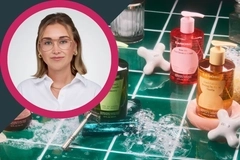
This is Benjamin Ferrer, reporting for Personal Care Insights, and I am joined today by Charlene Cheva, and she is the policy officer for Mercury at the European Environmental Bureau.
Hello.
Hi.
Could you tell us more about your organization and its function?
Yes, of course.
So, yes, I'm working for the the EEB, so the Environmental, the European Environmental Bureau.
We are a network organization that counts more or less, not more or less, we count 180 members from, 38 countries across the EU but also outside of the EU and we work on a variety of topics that are linked to the environment.
One of our main area of work is mercury.
As you may know, mercury is a global pollutant which knows no borders and can have really a devastating impact on both the people's health and the environment.
And that's why we decided to Create a group, that would work on that, specifically, specifically.
And so the EEB together with the MPP, the Mercury Policy Project, decided to set up, the Zero Mercury Working Group in 2005.
That group is now composed of 100 members NGOs from over 55 countries.
I would say that the original aim of that group, of that coalition was to advocate for the adoption of a legally binding treaty that would regulate the global demand, supply and trade of mercury.
That happened in 2017 when the Minamata Convention on Mercury was adopted, and since then we work more on policy implementation at both the EU and global level.
And one.
One focus area where we have been increasing our focus, more and more is actually the use of mercury into cosmetics.
And , can you explain to us why is mercury used in cosmetics to begin?
Yes, of course.
Mercury is added to skin lighteners, so it's mainly into skin lighteners that we are going to add mercury because it blocks the production of melanin, which is responsible for your skin color.
Skin lighteners are mainly used by women, by people of color from all over the world.
So in Asia, Africa, Latin America, but also in Europe.
It has cultural and historical origin, but it is now rooted into colorism, which is a form of discrimination that is based on your color and that is, that is happening within the same community.
So you get pressure from your family, from your community to lighten your skin.
The thing is, , adding mercury to skin lightening products can really have a profound impact on your health.
It can cause skin rashes.
It can cause skin discoloration.
It can lead to a reduction of your skin resistance to bacterial and fungal infection.
It can also enter your bloodstream and brain, so it's not going, it's not the impact is not only on the skin, but it goes beyond the skin.
And if you are a pregnant woman, it can also have a bad impact because mercury crossed the placenta barrier and it can also get into the mother's breast milk.
So it's kind of quite dangerous to use that kind of product.
And if we all know too about its poisoning effect, as you say, why does mercury continue to be added in these skin lightening products?
Mhm.
Indeed, because it is poisonous, it is actually banned in many countries, via various, , national legislation and even the Minamata Convention on Mercury that I was referring before, bans the manufacture, import and export of cosmetics with mercury content above one PPM.
So, it is kind of covered by a legislation, but in reality, mercury added products continue to be produced, continue to be merchant, merchant, advertised widely over.
Many different types of markets.
And I would say that the main factors are, , the colorism that I was mentioning before.
There is really, pressure from your community to lighten your skin.
It is associated with beauty, success and wealth.
This is reinforced clearly by the social media, by the beauty industry, which profit greatly from, from that market.
And another factor that we see is also the, the ease to access those products.
You can find them easily on online, platforms, on online marketplaces, and those are largely unregulated, and that allows for m created products to be, sold with impunity.
So that's, yeah, that's no problem.
And , what further steps can we take to tackle this issue based on work and?
There are different steps that we can do.
On all sides, we work towards, raising our awareness.
In 2017, we launched a campaign, the skin lightening campaign with the Zero Mercury working group.
So we purchase products, we test them, and we revealed that the results afterwards.
So far we've probably tested more, between 700 and 800 creams.
And I think that more or less, about 30% of them were containing mercury levels above 1 PPM, which is like quite significant.
So yeah, we try to raise awareness.
We, we also have developed developed a database, that government consumers can, can, can use and where you will find the results, but also, the list of things that are banned by governments.
What we see is that there is an illegal.
A clear illegal production and threat of those products, and there is clearly work to be made on regulation on regulating the online sales via via online marketplaces because there is a clear issue of accountability, a clear issue of transparency of online platforms, and that threatens consumers' protection.
So, that, that's also something we need to, to focus on, and yeah, better controlling, also those screens.
Yeah.
And really tackling the issue at the root, you know.
How, how can, in your view, in your view, how can we manufacture, how can we prevent the trade and manufacturing of these products?
I think, then we need to work on various aspects, on, on different fronts.
One of them is working with government.
Governments from Europe and beyond must work really together to improve the implementation of existing legislation, but also from, of the Minamata Convention that exists.
There are already good things there, so we need to implement them.
I believe also the private.
And public sector must work together to raise awareness about the dangers.
Really, not enough people know about them.
So there is a clear need to raise our awareness.
Based on the things that I was mentioning before, online marketplaces, must also be held accountable for what they're allowed to sell on their websites.
They should not facilitate the trade of illegal products.
So there is also some work to be done there.
Clearly, linked to maybe the issue of colorism, the beauty, film, and modeling industry.
They should stop promoting colorist ideals, promoting that lighter skin is more desirable or more beautiful.
So that, that must stop, clearly.
At the end of the day, people must be really able to make informed decisions and be able to buy products that are safe for themselves, but also for For the direct environments.
Thanks very much for your insight, Charlene.
Thank you.
Thanks a lot.