




Estée Lauder raises full-year outlook after first organic sales growth in four years


Key takeaways
- Estée Lauder has reported strong Q3 results, with double-digit growth in Fragrances and increased net sales in three regions.
- The company raised its FY 2026 outlook, projecting higher organic sales growth and improved operating margins for the first time in four years.
- The company’s growth was driven by restructuring plans and its multi-year vision, Beauty Reimagined.

The Estée Lauder Companies’ (ELC) Q3 report for FY 2026 has shown double-digit net sales growth in its Fragrances division. The year-to-date profitability has raised the company’s full-year fiscal outlook, expecting to bring a restoration of organic sales growth and expansion of adjusted operating margin for the first time in four years.
Net sales grew in three out of four geographic regions and were led by mainland China. The company’s multi-year vision, Beauty Imagined, launched in February 2025, is reported to be on track, and its Profit Recovery and Growth Plan (PRGP) is ahead of previous projections.
“Our third quarter results extend strong year-to-date performance, driven by Beauty Reimagined,” says Stéphane de La Faverie, president and CEO at ELC. “With momentum across all five action plan priorities of Beauty Reimagined, we raised our fiscal 2026 outlook, now expecting organic sales growth at the high-end of the prior range and adjusted operating margin expansion to approach 300 basis points, bolstered in part by adjusted gross margin expansion.”
De La Faverie states that 2026 is shaping up to be the “pivotal year [ELC] intended.” He projects that organic sales growth will recuperate and the adjusted operating margin will expand for the first time in four years.
“Looking ahead to fiscal 2027, we are confident in our improving trajectory and realizing the benefits of One ELC, especially its One Operating Ecosystem, which will be fully deployed. Our preliminary view is to accelerate organic sales growth and for adjusted operating margin to approach 13%, albeit in an uncertain geopolitical and macroeconomic environment,” he concluded.
Q3 at a glance
Overall, net sales for the company cashed in at US$3.71 billion, representing a 5% year-over-year increase, while organic sales grew by 2%. Reported and adjusted gross margin expanded 140 basis points, from 75% to 76.4%, demonstrating benefits from PRGP. The expansion helped offset inflation and tariff-related impacts.
Reported operating margin condensed 190 basis points, to 6.7% from 8.6% in the prior-year period, primarily due to restructuring and other charges of US$127 million and a US$84 million loss contingency. The blow came from a class action lawsuit by the US District Court for the Southern District of New York, on the grounds of alleged violations of the Securities Exchange Act of 1934.
Under the umbrella of its restructuring program, ELC is set to cut 3,000 more jobs in the coming months, primarily in department store positions. The company estimates that the final net reduction in positions will be approximately 9,000 to 10,000, an increase from 5,800 to 7,000.
ELC by segment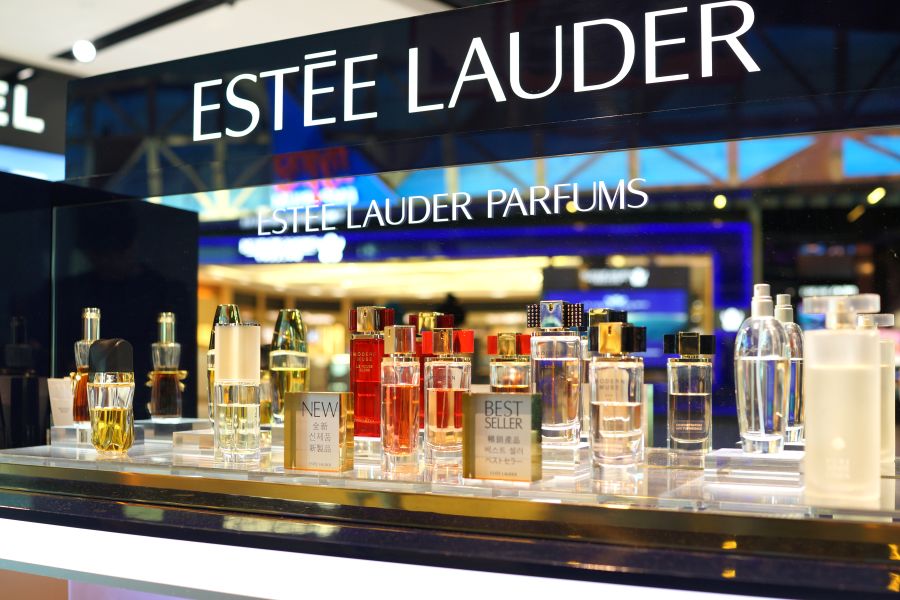
Fragrance segment sees double-digit growth across all regions.
The Fragrance segment’s net sales increased 10%, the group’s highest category. It benefited from double-digit growth in ELC’s Luxury Brands category across all geographic regions. The surge was led by Le Labo, Kilian Paris, Balmain Beauty, and Tom Ford.
Le Labo’s net sales were driven by its Classic Collection and innovations such as the launches of Violette 30 and perfuming hand creams. Kilian Paris also had a strong performance in Q3 with the Angels’ Share, and Love, Don’t Be Shy franchises.
The launch of Destin de Balmain eau de parfum, by Balmain Beauty, drove double-digit growth for the Fragrance category in the Americas. Net sales from Tom Ford also increased, benefiting from targeted expanded consumer reach and innovations.
The securities class action potential settlement of US$13 million caused the operating income decline in Fragrance. Excluding the impact of the settlement, operating income increased modestly, mainly due to an increase in gross profit from sales.
Makeup’s net sales remained virtually flat, but were partially offset by Clinique and Too Faced’s double-digit net sales drops. The segment’s overall operating results were a loss when including the impact of a potential settlement of US$35 million from the securities class action lawsuit. Excluding the impact of the suit, operating income increased and was driven by net sales and PRGP benefits.
Net sales in the Skin Care segment were also virtually flat. La Mer and The Ordinary drove growth, which was partially offset by declines from Clinique and Origins.
Double-digit net sales growth from The Ordinary was driven by targeted expanded consumer reach and growth in existing distribution, aided by innovation. Hero products in La Mer drove high single-digit net sales growth.
The serum subcategory caused a lull in Clinique’s net sales due to competitive year-on-year numbers. This was due to the launch of Moisture Surge Active Glow Serum the prior year, driving 2025’s sales. Softness in the moisturizer category slowed net sales in Origins, causing a double-digit decline.
Hair Care net sales were flat. The segment was primarily driven by the growth of The Ordinary and the performance of the Multi-Peptide Serum for Hair Density. The category’s numbers were offset by sales declines from Bumble and Bumble and Le Labo.
In the segment, operating results improved but remained in the negatives largely due to a US$9 million potential settlement of a securities class action lawsuit recorded in the Q3 fiscal 2026. When excluding the impact of the settlement, operating results improved, showing the advantageous results of PRGP, reducing non-consumer-facing expenses and disciplined expense management.
Business strategies for ELC
Beauty Reimagined propels Estée Lauder's fiscal 2026 outlook.
Over the past months, ELC has been diversifying and restructuring its operations and is said to be exploring potential investment avenues through acquisitions.
Last week, the company made a minority investment in 111Skin, a luxury clinical skin care brand. The move aligns with ELC’s focus on science-driven innovation, as 111SKIN creates clinically-led products.
ELC was also reported late last month to be arranging €5 billion (US$5.84 billion) in funding for the potential Puig merger after it was confirmed to be in talks with the Spanish beauty group. The beauty conglomerate was said to have commissioned JP Morgan to structure a financing package to fund its acquisition of Puig.
In its offloading endeavors, ELC was rumored to be considering the sale of Smashbox, Too Faced, and Dr. Jart+ as a package deal earlier this year. The combined price was estimated in the low nine figures (US$100 million to US$199.99 million).
In confirmed moves, the company announced it would acquire the remaining stakes in Forest Essentials, an Indian beauty brand focused on Ayurvedic cosmetics. The acquisition gave ELC full ownership of the brand.