

South Korea exports hit record US$7B as US demand surges


Key takeaways
- South Korean beauty exports reached US$7 billion in H1 2026, up 27.3% year-on-year.
- The US remains K-beauty’s largest export market, while skin care dominates overall cosmetics shipments.
- Government backing and retail expansion are strengthening South Korea’s position in the global beauty market.
South Korean cosmetic exports have hit US$7 billion in H1 2026, marking a 27.3% rise year-on-year, according to the country’s Ministry of Food and Drug Safety. The record-breaking export figures arrive after the US dethroned China as K-beauty’s global growth engine, and US consumers maintain their K-cosmetic appetite.
The US accounted for US$1.45 billion, 20.7% of the total South Korean cosmetic exports, and has seen a 41.5% surge from 2025. Meanwhile, China’s South Korean imports fell by 6.6% to US$1.01 billion, compared to H1 2025. China still makes up 14.4% of K-beauty exports and takes second place. Japan came in third with US$580 million, increasing its South Korean imports by 5.9%.
K-cosmetics’ exports’ rapid growth is not showing signs of losing momentum, with growth of 25.8% within the first half of 2026 from US$3.1 billion in Q1 to US$3.9 billion in Q2.
South Korean beauty hit its annual export record in 2025 with US$11.4 billion. H1 2026’s current US$7 billion represents over half (61.4%) of this figure, indicating that K-beauty may beat its own beauty record when 2026 draws to a close.
K-beauty’s exports have skyrocketed since US$1.07 billion in 2012, building from an evergreen international interest for its personal care products. The country’s beauty market is increasingly solidifying itself as one of the global cosmetics industry’s most lucrative areas.
Momentum defies macroeconomic pressure
K-beauty exports to the US have continued to rise despite the country’s 15% tariffs on imports from South Korea, imposed last year, which included some cosmetics. According to Seoul Economic Daily, analysts say consumers stocked up ahead of anticipated price hikes due to the imposition of the reciprocal tariffs.
“As exports diversify around indie brands, dependence on any single country or large company has declined,” says the ministry, according to Seoul Economic Daily. “The global standing of Korean cosmetics is rising structurally.”
Skin care was the frontrunner of the country’s cosmetic exports, cashing in at US$5.48 billion and making up 78% of total exports according to the news source. The figure marks a 25% year-over-year increase according to the South Korean Ministry of Food and Drug Safety.
South Korea is strengthening policy support for its growing cosmetics industry,
This marks a change from earlier this year, when export data from the Korea International Trade Association showed the country’s fragrance exports reached a record US$6.52 million in January 2026. The figure marked the highest monthly figure since records began in 1988, pointing to the rise of “K-fragrance” as a new export driver.
The US saw a year-over-year increase of US$360 million (+48.6%) in “basic cosmetics” and a US$20 million increase (+36.4%) in body cleansing products, while color cosmetics decreased by $1 million (-0.7%) according to the Ministry of Food and Drug Safety.
While the US generally grew, Chinese exports saw an overall decline. “Basic cosmetics” decreased by US$60 million (-7.2%) year-over-year, color cosmetics decreased by US$4 billion (-0.3%), and body cleansing products decreased by US$18 million (-25.0%).
South Korea’s ministries invest in beauty
South Korea is leveraging the K-beauty boom as a strategic stronghold by backing up its commercial golden goose on a policy level.
Last month, the country passed legislation to develop its beauty industry into a primary engine of national economic growth. The move marked its first legal framework made specifically to cultivate the commercial development of the sector.
The Cosmetics Industry Promotion Act will provide a legal foundation to support the entire cosmetics ecosystem and give the Ministry of Health and Welfare formal authority to help cosmetics brands, manufacturers, R&D, raw materials, ingredients, packaging, and distribution.
In June, Personal Care Insights covered South Korea’s Minister of Finance’s announcement that the country’s government will actively foster the cosmetics industry as an export growth engine. The move came as the country broke US$3.1 billion in exports in Q1, aiming to capitalize on the surging global demand for K-beauty products.
Competition for first place
South Korea’s exports hit US$11.4 billion in 2025, placing it in second place of global shipments, overtaking the US at US$10.8 billion. K-beauty presently trails behind France, which sits at roughly US$24 billion. K-beauty's global momentum is increasing competition in the international beauty market.
France leads by a comfortable margin with over double South Korea’s exports, driven by its long-standing luxury beauty dominance.
However, while France dominates beauty with its luxury offerings, Ulta has placed K-beauty brands Medicube, Anua, and Peach & Lily at the focus of its premium category. Meanwhile, on Amazon, Medicube has made up 14.1% of beauty sales in Q1 2026, and Beauty of Joseon sunscreen has become a consistent seller.
K-beauty brands’ premium appeal may indicate that South Korea is also moving into luxury, posing a potential threat to French exports’ long-standing domain.
The influence of South Korean popular culture is also playing a part in many global premium beauty brands’ positioning. For example, K-pop boy band BTS’s Jungkook is sitting as a Chanel Beauty ambassador, and K-pop girl group IVE’s Jang Won-young is a Miu Miu Beauty ambassador.
K-beauty’s unwavering pace indicates that competition for beauty export lead may become tighter in the near future.
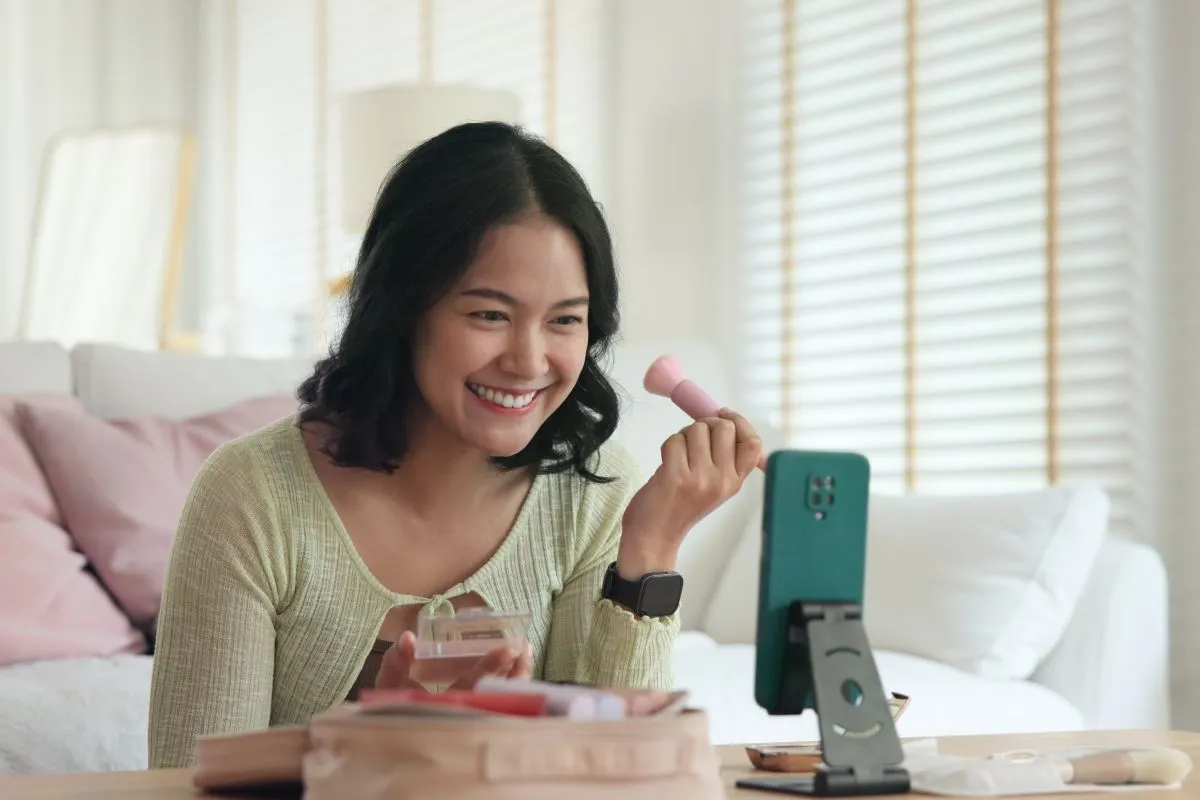
K-beauty brands are expanding their presence across major US retailers.
US consumers and K-beauty
K-beauty has made strides in the US with Olive Young debuting in the country with its first brick-and-mortar store in May 2026. The Pasadena store has been attracting sizable interest from US consumers, who queued up in front of the store the day before its doors officially opened, forming a line of hundreds.
The store averages over 1,500 visitors a day, according to the retailer. The 803-square-meter store features 400 brands, carrying approximately 5,000 products. Asia Business Daily reports that over 90% of the brands are South Korean.
Last month, Olive Young parent CJ outlined a target of ₩12 trillion (US$8.7 billion) in North American sales by 2028. The group plans to connect its food, content, and beauty businesses as part of a wider K-lifestyle growth strategy, with Olive Young playing a key role in its beauty expansion.
Alongside the Pasadena store, Sephora and Olive Young partnered to bring K-beauty to Sephora consumers globally at over 500 stores.